
Micro-Perks
Building owners are beginning to see the benefit of including microturbines in onsite power plans for commercial, industrial, and urban-residential projects.
Wednesday, June 30, 2010
By Dan Rafter
Building owners need to do everything they can to attract tenants, especially in today’s challenging economy. That’s why Joel Wilson, chief executive officer of Norwalk, CT-based OfficePower Energy Solutions, wasn’t surprised when the owner of the 1350 Avenue of the Americas office building in Manhattan, NY, hired his company to install and operate a dozen natural-gas-powered Capstone microturbines on the 35-story building’s 16th floor.
The microturbines, which generate enough electricity to provide for more than a third of the building’s daily power needs, are one more benefit, and an important one, that the building’s owners can cite when pitching 1350 Avenue of the Americas to potential tenants. “The building owners are always looking to attract and retain the highest-quality tenants for their buildings,” says Wilson. “They do things that the tenants will perceive as valuable to them. Certainly, a strengthened building infrastructure, the ability to provide backup energy to buildings in a blackout, and the environmental benefits of onsite power generation are all things that are factors in why tenants would want to locate in a particular building. And because of this, these are all factors in why building owners would be interested in bringing onsite power-generation plants to their buildings.”
Wilson’s experiences aren’t unique. A growing number of providers in his field—companies that install onsite power plants made up of gas-fired turbines or microturbines in office, industrial, and retail buildings—are finding that building owners are seeking out onsite power systems to help them attract tenants in this challenging commercial real estate market.
The Great Recession has played havoc with the commercial real estate business. Retail strip centers, industrial parks, medical centers, and apartment buildings are all suffering from higher vacancy rates. But of all the commercial sectors, the office market may be suffering the most. Vacancies in office buildings have been skyrocketing ever since the start of the recession. And it’s a trend that real estate analysts don’t expect to slow anytime soon.
 |
Photo: Capstone Turbine Corporation
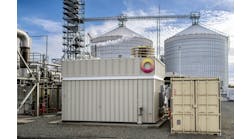
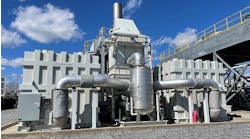
The CR200 turbine will produce 1.7 million kWh each year to supply the plant’s electrical power needs. |
 |
Photo: OfficePower
Above and Below: The installation at 1350 Avenue of the Americas represented the first onsite powersystem of its kind in New York City. |
 |
The owners of office buildings, then, need every advantage they can get in filling vacancies. Marcus & Millichap, a national real estate services firm, estimates that the nation’s office vacancy rate will increase to 18% in 2010. That’s a bump of 100 basis points from 2009. This represents a significant increase in empty office space.
At the same time, offices asking rents will fall 3.5% in 2010, according to Marcus & Millichap’s estimates. Actual rents—the ones that tenants really pay—will fall even more in 2010, by 5.2%.
Because of this, building owners must do everything they can to make their buildings attractive to tenants, in what has certainly become a renter’s market. Certain amenities, of course, will always attract tenants. These usually include easy access to major highways, new buildings with more modern office space, and plenty of onsite parking.
Onsite power plants may not seem like an obvious benefit to add to this list, but, Wilson says, “it does” help building owners attract two kinds of tenants: those who demand a reliable power source and those who are interested in working in a building that is environmentally friendly. After all, what is “greener” than onsite power generation, an amenity that reduces the demands that an office building places on the probably overstrained public power grid?
“We are working on half-a-dozen new projects right now,” says Wilson. “The owners of these buildings have the view right now that they have to strengthen their buildings’ energy infrastructures to retain and attract the best tenants. They understand that these onsite systems increase their bottom lines. And microturbines make the most sense for many building owners.”
Reliability in Manhattan
The public electric grid serving Manhattan is aging. Building owners here know it. And that aging infrastructure is one reason why the owners of 1350 Avenue of the Americas office building decided to seek bids for an onsite power plant in their building.
The plant serves as a hedge against the sometimes-unreliable public grid. In the event of a blackout, the 1350 Avenues of the America tower will be one of the few office buildings still burning brightly, thanks to the Capstone microturbines humming along on its 16th floor.
The office building relies on a dozen Capstone C60 High Pressure Dual Mode ICHP units, that together form an onsite power plant that generates 750 kW of electricity. This accounts for about 35% of the building’s daily electricity demands. It also means that the building does not place as great a strain on the already overburdened public power grid.
The microturbine power plant went into operation in August of 2006. Since then, it has boasted a 99.4% availability rate. This is a figure that is almost unheard of for distributed-generation systems.
The onsite power plant is also a glimpse into the future of New York City, NY. The city’s mayor, Michael Bloomberg, has determined that combined-heat-and-power systems, of which the Capstone microturbine plant at 1350 Avenues of the Americas is an example, are a crucial part of New York City’s power-generation plans for the future, something spelled out in Bloomberg’s PlaNYC 2030.
Wilson, for one, thinks that New York might be leading the way to a future dotted with an ever-increasing number of onsite power plants fueled by natural-gas-powered turbines. He says he has already seen an increased demand for his company’s services, as both municipalities and private building owners recognize the many benefits of onsite generation plants powered by microturbines and turbines.
His company, OfficePower, is in the process of installing or planning onsite microturbine plants in several other well-known locations in New York City. These spots include buildings at 200 Park Ave., 220 E. 42nd St., 230 Park Ave., and 666 5th Ave.
The installation at 1350 Avenue of the Americas, though, represented the first onsite power system of its kind in New York City. That posed a challenge to OfficePower.
“The real challenge wasn’t in the actual physical installation. That was fairly simple,” says Wilson. “The real challenge was that this was the first of its kind in the city. So we had to work with the city on getting the right building codes approved. We were the first in the city installing a microturbine/combined-heat-and-power plant in Manhattan that was approved for both parallel and backup energy. Getting everything approved in a situation like this always involves a process that takes time.”
But in OfficePower’s case, patience paid off. In 2006, the company received permission to install its microturbine onsite generation system at the building. Today, as it continues to run effectively and efficiently, this onsite power plant serves as a model for other building owners in New York City who are hoping to improve their energy reliability, too.
“New York City is a very professional place in which to do business,” says Wilson. “I’m not surprised that the city is promoting these kinds of installations today. And I’m not surprised that the city considers onsite power generation to be so important. The Avenue of the Americas project is working very well right now. It is meeting and exceeding all of our expectations, and that means it is a very good advertisement for this sort of installation.”
A Bright Future for Turbines
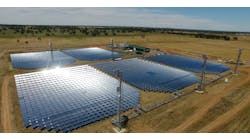
Though Israel-based AORA has developed and is marketing a solar-hybrid power generation unit, the company also depends heavily on turbines. That’s because AORA’s solar thermal technology relies on turbines. The company’s hybrid power units rely on the heat of the sun to fuel microturbines, providing onsite power to buildings.
The AORA solar generation unit, then, marks the first commercial use of what the company calls a solarized gas microturbine.
Pinchas Doron, AORA’s chief technology officer, says that microturbines are a natural fit for his company’s solar plants, which are basically modular units made up of small base units that building owners can string together.
“The microturbine can be easily adapted to an external heat source, features easy and infrequent maintenance and service, low emissions, and fuel flexibility,” says Doron, in explaining why they work so well with his company’s solar power units.
His company’s reliance on turbines is just one example of the growing demand for these engines, Doron says. Building owners, corporations, and municipal users across the globe are investing in onsite power plants. And microturbines and turbines are naturals for powering these onsite plants, Doron says.
This is especially true for users in need of applications that require both heat and power, such as farming communities in Spain, Doron says. He adds that locations that do not have grid power, but do require a comprehensive energy solution, such as villages in India, can also benefit from microturbine- or standard turbine-powered onsite power plants.
Doron points, too, to remote locations such as mining towns in Australia that can benefit from onsite power plants fueled by turbines. “There is a vast demand for such systems,” he says.
When Jim Crouse looks at the future of turbines and microturbines, he sees a bright one. He’s executive vice president of sales and marketing at Capstone Turbine Corp., one of the biggest players in the turbine business, so he’s familiar with the industry.
And he sees a business climate in which building owners are looking for ways to not only provide more reliable power, but to save on their energy costs, too. Turbines can help them reach both of these goals.
Just as importantly, Crouse sees a world in which more businesses, municipalities and transportation providers are turning to technology to reduce the amount of emissions their buildings and vehicles produce. It’s all part of the country’s still surging “green” movement. “We’ve worked hard here over the last two years to really continue to bring down the emissions our turbines and microturbines produce,” says Crouse. “When you look at the microturbine and turbine business, the trend now is to have cleaner-burning power plants. We’ve done this through enhancements in software and other technologies.”
Because of the drive toward greener living, Crouse says, Capstone is seeing renewed interest from municipalities that are considering using microturbines to help power hybrid electric vehicles. The company, for instance, recently displayed a car at the Los Angeles Auto Show that had a Capstone C30 microturbine installed as a range extender. The company is now seeing more interest from municipalities that want to use microturbines to help power their buses, something that they recognize is a good way to reduce emissions.
As an example, Crouse points to the DesignLine Corporation. Headquartered in Charlotte, NC, the company is known for the hybrid buses it manufactures. A combination of batteries and small microturbines fueled by natural gas power these vehicles. The company is now using Capstone’s C30 and C65 microturbines for range extension in these hybrid city buses.
“There is a lot of potential in the transportation market,” says Crouse. “The good news is that it is a higher-volume market. The bad news is that it is more price-sensitive than stationary applications are. It’s a market that has its own share of challenges. But it’s a good and growing market. Microturbines are particularly well suited to this market, too. We don’t need any exhaust after-treatment to meet emission requirements, which is something that the municipalities using hybrid buses and vehicles appreciate.”
Capstone has also broken into some new markets recently, Crouse says. This is largely because of the increased commercialization of the company’s C200 microturbines, he explains.
Capstone now packages the C200, so that it is available in 600-, 800- and 1,000-kW versions, Crouse says. This means that three, four, or five C200 microturbines come in a single box, complete with integrated controls, a single fuel connection, and a single electrical connection.
“With that product, we’ve seen a lot of growth in some markets that we traditionally hadn’t been selling microturbines in,” says Crouse. “We are seeing growth in oil and gas applications, and in remote larger power applications that would have used an internal combustion engine in the past. We are now offering these applications a choice to go with microturbines that they didn’t have in the past.”
Crouse points to several factors as driving the increased popularity of microturbines and turbines among business and building owners. Energy costs have continued their rise during the last decade, a trend that has forced building owners and businesses to look for cheaper alternatives to relying entirely on the public power grid.
Then there’s the increased media attention to climate-change issues and carbon reduction. That is in the news every day, it seems. “What are the options that people have for efficiency improvements?” asks Crouse. “What are the choices they have for carbon reduction? We are a very good choice to help in both of these areas.”
Crouse also expects good things when it comes to the future demand for microturbines and turbines. “The demand will definitely grow for our technology,” he says. “We have a cleaner and more environmentally friendly solution than the incumbent. We think that the incumbents will lose market share when environmental considerations, and maintenance cares lead more clients to choose microturbines instead of other options.”
For instance, Crouse points to the potential for microturbine use in the agricultural industry. There is still untapped potential for digesting animal and green wastes and feeding it into microturbines, Crouse says.
Crouse predicts that the microturbine and turbine industry will grow even faster if the US government puts into place economic policies that make it cost-effective for customers to take on renewable energy projects. In Crouse’s ideal world, policymakers would enact long-term strategies that encourage businesses to use microturbine and turbine technology, something that would give the industry a true push.
This could include long-term contracts for renewable energy projects that are similar to the individual contracts that the producers of wind power can negotiate with utilities, Crouse says. He’d like to see more universal rules that encourage businesses to adopt small-scale renewable energy, instead of the current system of 50 states that all seem to have their own rules and incentives.
“The market is really ripe; this is a really good time for us,” says Crouse. “I don’t see a lot of hurdles or barriers to the ability we have to deploy our technology. It’s all primarily economics. For cogeneration in general, things are good and will continue to get better.”
A Global Impact
Microturbines and turbines have made a significant impact across the globe. That includes in Italy, where the managers of the Cossato Spolina wastewater treatment plant in Cossato have discovered just how efficient their operations can be, thanks to the power of onsite turbines.
Up until the spring of 2009, the wastewater treatment plant’s carbon footprint included a flare that burned continuously above the facility. Biogas that had been considered a nuisance byproduct of the water-treatment process fueled that fuel.
That changed, though, last spring. Managers of the Cossato Spolina plant had decided it was time to harness the wasted energy that was stored in their plant’s waste biogas.
Today, one Capstone CR200 turbine provides all of the electrical power that the plant needs to operate. It also generates enough heat to make the plant’s digesters work at their peak levels of efficiency.
The numbers tell the story of this installation’s success: The CR200 turbine will produce 1.7 million kWh each year to supply the plant’s electrical power needs. It does this by using as fuel the 2,600 cubic meters of biogas from the plant that had previously burned away as waste.
At the same time, an external heat exchanger installed with the plant’s microturbine delivers another 2.3 million kWh of thermal energy that warms the treatment center’s digesters. Not only is this arrangement an efficient one for the plant, it’s also beneficial to the environment. The combined heat and power produced from the microturbine will slash the emissions of carbon dioxide at the plant by 1.8 tons every year.
Ilario Vigani, a senior sales executive with Integrated Building Technologies SRL, the Capstone Turbine distributor based in Treviso, Italy, says that the microturbine installation at the Cossato wastewater plant could serve as a model for other potential clients. “Capstone biogas technology is very useful in dealing with the biogas produced by waste water treatment plants because it is so flexible,” says Vigani. “The biogas production in wastewater treatment plants is not normally constant. It requires a flexible engine like a turbine that can burn the biogas properly. This kind of fuel is a renewable energy, too. In many European countries, there are incentives for working with renewable energy.”
Vigani says that at the Cossato plant, these incentives translate to about 10 Eurocents for each kilowatt-hour of electricity produced by the onsite turbine. This helps boost the payback that the Cossato plant receives for investing in the microturbine. Vigani says that the plant will cover the cost of the microturbine in about two years.
There is one black cloud, though, hanging over the microturbine and turbine industry in Italy, and it’s the same one hanging over many countries: the global economic slump. “We saw last year in Italy a decrease of investment in these because of financial problems,” says Vigani. “But starting from the last quarter of 2009, we have noticed that the market is restarting. We are planning to install microturbines in about six plants in 2010 that are similar to the one in Cossato in Italy.”
Looking for a Turbine Boom
Kurt Liebendorfer also sees a bright future for turbines and microturbines. He’s vice president of Jacksonville, FL-based Stellar, a company that offers specialty services, turnkey solutions, and modular add-ons to boost the onsite steam, heat, electricity, and refrigeration systems of clients. This includes augmentation technologies that help turbines produce more power.
For the last 18 months, Liebendorfer says, he’s seen flat sales in the turbine industry, especially in the larger frame-size turbines. There’s a reason for this, of course: The country’s terrible economic slump has made life difficult for the large utilities or power plants that would purchase these new larger turbines.
The sales of medium-size turbines and microturbines have been stronger, Liebendorfer says. But even this industry has not been seeing quick growth during the economic slump, he says. “They aren’t falling off the cliff, but they’re not jumping for joy, either,” says Liebendorfer.
But when it comes to the future, Liebendorfer is more optimistic. He, like many other observers in the industry, sees better times ahead for the turbine business. “Everyone is sensing that this market is poised to change,” he says. “The economy coming back slowly in combination with the energy regulatory environment will hopefully provide some opportunities for the turbine market. I think the market is well-positioned to be the beneficiary of whatever regulations will come on regarding climate change.”
The reason for this last point, Liebendorfer says, is that turbines act as bridges between traditional fossil fuels and renewable energy. The big challenge with renewable energy is that it is not available in the size needed to replace fossil fuels. Turbines powered by natural gas, though, can provide enough onsite power to wean office buildings and industrial plants off of fossil fuels, Liebendorfer says. “We are pretty excited about being positioned in this turbine market that I think will start to expand in 2011 and beyond,” he says.
Retrofitting has become an important market for Stellar. While new turbine sales may be largely flat, a growing number of owners are looking to retrofit the turbines at their existing facilities with augmentation technology that causes the turbines to produce extra electrical output.
For Stellar, this market is made up largely of municipal-owned buildings, electric co-ops, and some of the larger municipally owned utilities that no longer want to import outside power. “The augmentation technology is less costly than are new capital asset expenditures,” says Liebendorfer. “When things are booming, people put in more intensive power projects. These augmentation technologies, though, have a lower dollar cost per kilowatt. They are more in favor during the slower times. In booming times, the tendency is more toward putting in the generating asset itself.”
A Power Boost in Oklahoma
Western Farmers Electric Cooperative is a perfect example of today’s market for turbines. The utility cooperative that serves about three-quarters of the rural areas of Oklahoma—which comes out to about 240,000 customers—in June 2009, added three LM6000 microturbines from General Electric to its onsite power capabilities.
Western Farmers, though, faced a challenge, according to John Toland, the cooperative’s resource planning engineer. Combustion turbines in Oklahoma tend to loss much of their capacity in the summer because of the heat and elevation in the state. While a turbine might generate 50 MW of power at 59 degrees, it might slip to 40 or 42 MW in the 100-degree heat and 1,200-foot elevation level of Oklahoma, Toland says.
To solve this problem, Western Farmers purchased three chilling units from Stellar that provided about 4,800 tons of instant cooling. The goal was to lower the ambient temperature for the microturbines to about 48 degrees, even on days that boasted 98-degree heat, Toland says. “We know by experience that without chilling, you can’t get the full load out during the summer,” says Toland.
And this isn’t something that anyone associated with Western Farmers wants. If the cooperative can’t produce its full load, it then either has to provide energy through less-efficient units or buy it off the market.
Today, though, the microturbines in Oklahoma are performing well, Toland says. The project of installing the LM6000s even came in under budget, something that made Toland happy.
Liebendorfer, and others in the turbine business, point to success stories such as this as the reason for all the optimism regarding the future of turbines.
Author's Bio: Dan Rafter is a technical writer and frequent contributor. |
Advertisement]