
The New Cool at School
One high school’s energy-storage system is chillin’.
Wednesday, October 31, 2007
By Lori Lovely
When it opens for the 2008 school year, brand-new Hampshire High School in Hampshire, IL, will serve as a model of forward thinking in more ways than one. The approximately 4,000-square-foot building will incorporate a thermal energy storage system that will provide such benefits as reduced operating cost, operational flexibility, and lower hydrogen emissions.
Recognizing that reducing energy consumption benefits the school, community, and environment, Charles Bumbales, assistant superintendent for School District 300, is proud to set a good example by incorporating thermal technology. “We’re committed to a viable long-term solution to provide a good energy management system. This makes tremendous sense,” he says.
Although it makes sense, it nearly didn’t happen, due to financial constraints. Budgets for the new school were set in the 2004–2005 school year, before the cost of materials escalated. “The average per-square-foot amount went up as much as 20% due to the cost of raw materials, such as copper, and to labor contracts,” Bumbales reveals. “Before bidding the project, we had looked at other projects in the area to get an idea, but since we didn’t bid until two to three years after we determined our budget, we had to re-evaluate our bid number.”
Ron Kozanecki, consulting specifying engineer for Metro Design Associates, readily acknowledges the tight budget the school required them to work within. “The school wanted ice storage, but we had to prove to the school and the construction manager that we could do it within budget.”
To prove it, Metro—with the help of district architect Burnidge Cassel Associates—produced two designs, a base bid with a standard system and an alternate bid with the thermal storage system, also called ice storage system (ISS). “We couldn’t go as much as $20 over [budget],” Kozanecki reports. “If the first cost was too high, we couldn’t do it, even if the payback was in two years. The bottom line was the budget.”
“You need to find a balance between the first cost and the energy savings,” advises Dave Spence, Trane account manager. “You can size the tanks and chillers to achieve different goals. A full-storage system would require bigger chillers or more chillers to make ice; that would double equipment costs, but provide more energy savings. With a partial-storage system, energy savings are usually 40% to 60%, with payback in two to three years.”
In the end, the initial cost of the ISS for Hampshire High was $252,180 higher than a cooling system without thermal storage, but it was still within budget, so the school opted for the greener alternative. Kozanecki points out that the life-cycle payback on investment is 2.7 years and that over the life of the system the school district “would be able to realize over $1 million of cost savings with the ice storage system, based on current rates.”
History Class: Thermal Tech 101
Thermal storage isn’t new. According to some sources, the measurement of cooling capacity in “tons” stems from the days when ice was carried down the mountains to be used in cities as a coolant: one ton of cooling capacity equaled the amount of heat required to melt one ton of ice in a 24-hour period. These days, mechanical refrigeration has replaced ice harvesting, and cooling is measured in Btus. One ton of HVAC capacity equals 12,000 Btus per hour.
Thermal storage has remained an effective way of cooling for decades; in the early twentieth century, ice was placed in air ducts to cool and dehumidify air blown by fans. It wasn’t until the other end of that century that the first ice storage system was built by the Colorado Automatic Refrigerator Co.
Today, thermal energy storage has moved beyond the ice block. It now covers a broader spectrum of technologies to store energy in a thermal reservoir. All the current methods use one of three basic media for cool storage: chilled water, ice, and eutetic salts. One or more of these is incorporated in the many methods of cool storage—chilled water storage, ice thermal storage, ice harvesting, external melt ice-on-coil, internal melt ice-on-coil, encapsulated ice, and ice slurry among them. Water is the most commonly used medium. The choice of storage media determines the size of the storage tank and configuration of the HVAC system. ISSs provide the densest storage capacity but require the most complex charge/discharge equipment.
Although ice thermal storage is still the most common application these days, it involves the storage of cooling energy through production of ice or chilled water at night when utility rates are low. The system then releases that stored energy to cool buildings during the day when the electricity rates are high, thereby reducing utility usage during peak times. This load-shifting technology reduces cooling costs.
The system is successful thanks to water’s high latent heat of fusion, the amount of thermal energy that must be absorbed for one mole of a substance to change states from a solid to a liquid. Special ice-making equipment or standard chillers modified for low-temperature service charge fluid at temperatures below the average operating range of typical air-conditioning equipment.
There are two basic strategies for charging/discharging (cooling) storage to meet cooling demand during peak hours. Load shifting is a full-storage strategy that shifts the entire on-peak cooling load to off-peak hours. It is especially beneficial where on-peak demand charges are particularly high. Tank capacity must be sufficient to meet the entire energy requirement and chiller capacity must be sufficient to recharge the tank overnight.
With a partial-storage strategy, a smaller chiller and tank are adequate, with the chiller plant providing part of the peak cooling load. Partial storage systems may be operated as load-leveling or demand-limiting. In a load-leveling system, the chiller is appropriately sized to operate at full capacity for 24 hours on the hottest day; it is effective in areas where peak cooling load is higher than the average load. In a demand-limiting system, the chiller operates at reduced capacity during on-peak hours and can be controlled to limit a facility’s peak maximum demand charge.
ISS Passes the Test
Thermal storage is an economics-driven strategy with the objective of reducing on-peak electricity demand. Summertime peak loads drive the electricity generation industry, which meets those peak loads with low-efficiency peaking power plants that have high fuel costs. Because electricity consumed during overnight off-peak hours can be produced at much lower cost, many utility companies pass along the savings to customers in the form of time of use (TOU) or real-time pricing (RTP) rates. TOU tariffs are the lowest-cost tariffs—typically an off-peak, overnight time.
 |
| Thermal storage has remained an effective way of cooling for decades. |
“Most utility rates penalize peak usage,” offers Spence. “Utility companies prefer flat rate usage because it costs them more to make electricity during the day than at night.” He explains that because companies buy electricity on contact, they’re in a more advantageous position to negotiate a better rate if they load-shed.
HVAC units, particularly in large commercial and public buildings, contribute heavily to peak electrical loads on hot days, driving up utility costs for businesses and schools. “Large buildings are typically cooled by low-temperature water that is generated in a central location and distributed to equipment that uses the cold water to make cold air for the rooms,” Spence describes a conventional cooling system. “The large water coolers called ‘liquid chillers’ use large quantities of energy due to size and ventilation requirements. This results in five-figure monthly energy bills during the cooling season.” It also presents opportunities for energy savings by incorporating ISS technology.
Not only do they take advantage of lower off-peak rates, ice-storage systems offset the cost of energy consumption by producing lower condensation temperatures. Although an ISS requires the lowest evaporator temperatures, nighttime operation improves the efficiency of chillers, particularly air-cooled chillers. Because heat is discharged into cooler nighttime air, chillers are more efficient. Chiller efficiency is also improved by operating around the clock because it reduces partial-load losses.
Additional savings can be found by supplying near-freezing water to air-handling units, cooling returning air up to 40% and thus requiring less cooled air. The reduction in airflow allows the use of smaller, less-expensive air handlers and ducting. It also reduces power consumption by ventilation fans. In addition, the cooler air reduces humidity, which improves comfort and provides other advantages. “Humidity causes mold and renders buildings unusable,” Spence elaborates. “St. Charles had to close its new high school due to mold. Dehumidification through lower temperatures helps alleviate maintenance, health, and environmental issues.”
In addition to the direct benefits, lower energy consumption equates to lower emissions and reduced environmental impact. By shifting loads from low-efficiency peaking generators during the day to high-efficiency baseload generators at night, ice storage reduces fossil-fuel use and air pollution. When coal and uranium are used to produce electricity at night, less imported fuel is consumed. Also, because inefficient “peaker” plants are replaced by low-emission baseload facilities producing electricity overnight, emissions are further reduced. Compounding that benefit, by lessening the load factor on electricity plants during peak hours, fewer plants are needed to service the load.
Apply Ice
“The idea came from Metro,” Bumbales recalls. “They educated us on the product; their expertise drove the decision.” After touring a smaller school with a thermal storage system and analyzing energy consumption data, the assistant superintendent asked Metro to calculate long-term costs and payback time.
In business since 1988, Metro has recently designed systems for eight elementary schools and a new high school and has upgraded or expanded systems in three other high schools. In fact, 70% of its work is in the school market, although Kozanecki indicates the company is “getting into high-performance buildings.” Silver LEED-certified projects have garnered attention for the Elgin, IL–based company that bills $3.5 million in design fees per year.
“We’ve done ice storage before,” Kozanecki sums up. “We always tailor the system to the building; they’re all different.” The amount of cooling required can change in different climates. In Arizona, for instance, more ice-storage tanks might be needed due to the sheer demand change and a different load profile. The system helps in warmer climates because more load can be shed to ice banks, providing more payback. “The more cooling capacity you need, the more advantageous the system is.”
For Hampshire High School, Metro “did a comprehensive load system analysis with our design software to find the peak system load,” Kozanecki details. “That gives us the required amount of diversified tonnage for the building to develop capacity cooling. We needed 1,000 tons of cooling to satisfy the load requirement on that day; that determined how much cooling we needed. We took that information, profiled it, and extrapolated it to determine how many tanks we needed to meet capacity for building conditions such as occupancy. With 100% capacity chillers, we need 1,000 tons of cooling for occupancy comfort in the building.”
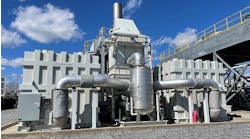
The system Metro came up with includes six cells of three Calmac 1500 ice tanks and two Trane RTAC 300 rotary-screw chillers of 300 tons each. The base bid without ice storage called for two 500-ton chillers, so already, Kozanecki points out, there was a savings by opting for the ISS strategy with smaller chillers.
The dual-temperature Trane chiller functions as the heart of the ISS, operating in standard cooling mode during the day and in ice-making mode at night. The ice is stored in tanks until needed to provide cooling to the building the next day.
Under the partial storage system, the Trane chillers produce a 22°F antifreeze solution at night when energy costs are low. It’s pumped through poly tubing coiled in an insulated tank of a water/antifreeze mix, which partially freezes around the tubes. The clear plastic continuous tubing has no joints, so there are fewer chances of leaks. The ice is then melted during the day, when energy costs are high.
The chillers run to supplement the ice on hotter days, creating “the best balance of first cost and energy savings, resulting in the fastest payback,” according to Spence. On mild days, the ice is used without chillers, providing additional savings.
The chillers may be smaller, but both proposed designs called for the same size chiller yard, Kozanecki points out, although he admits that it’s the ISS design that requires an extra 18 feet in length.
Installation of the chillers on a concrete pad in a courtyard behind the school will take a two-man crew approximately two to three 80-hour weeks to complete, based on previous experience at another high school job, estimates Dean Powrozek, vice president of operations for International Piping Systems, who spent a busy summer coordinating delivery and installation of the ice banks, piping, valves, and pipe valve fittings.
Payday
Installation generates attention, but ongoing routine maintenance can make or break a budget. Typically, ISS is easy on both. In addition to increasing a cooling system’s peak capacity without extra chillers or electricity requirements, a thermal storage system usually lowers capital and maintenance costs.
Even so, maintenance was not an important consideration in making the decision, Kozanecki believes, because there is little difference in the cost of ongoing routine maintenance between the ISS and the standard cooling systems. “Over time, the maintenance cost may be a little less, but it’s really a wash.” He says that chillers under 200 tons provide more cost savings in regards to refrigerant and condensers, but says ice tanks are simple: “Check for water every spring and fill as needed.”
As Spence says, the Calmac ice tanks are passive and “essentially require no professional maintenance.” Because the tank is a “sealed bucket” instead of a pressure vessel, he explains, there is a slight evaporation rate that might require topping off with a solution of water and 3% glycol once a year.
Other savings are of greater benefit. “Load-shedding is Number One,” Kozanecki insists. “The lack of peak demand makes a big difference.” Because the ice tanks require no electricity, electric load can be reduced by using them. Similarly, chillers use less electricity, contributing to reducing electric load.
One way Metro stayed under budget was by incorporating air handlers with energy recovery to keep chiller size at a minimum. Coil sizes were also reduced, thanks to better latent cooling. “You get better performance out of the building’s chilled water coils. The need to run chilled water temperatures lower with colder water gets better capacity out of the coils, so you can reduce pipe size. Because the water is already cooler, you get better performance. We pick up six degrees of cooling from the ice. It’s common practice in this area to run 10 degrees of Delta(T)…about 45 degrees to 55 degrees. Because of higher storage, we have a higher Delta(T) of about 16 degrees.”
In addition to energy conservation, indoor air quality was a high priority for District 300. The energy recovery modules that are part of Trane’s M-series climate changers keep energy consumption low, while providing better air quality and higher rates of ventilation.
As Spence puts it, the system results in significantly less energy used, which ultimately results in significantly lower fuel bills. “The benefits are tremendous cost savings, more efficient cooling, and a reduction in greenhouse-gas emissions.” Another environmental benefit provided by the system is that it can be used to earn Leadership in Energy and Environmental Design (LEED) points in the energy, environmental, and innovative design categories.
Control Is Cool
Contributing to the energy load reduction is the ability to regulate the system. School District 300 runs a Johnson Controls energy management system that operates light and plumbing fixtures. Bumbales is pleased that Metro could “work the four-pipe chiller system into that so we can control what we do.”
The building is never completely shut down, even during the summer, but some sections are little used. With zone control, Bumbales has more set points to control for humidity and for areas in use by summer school classes, camps or administrative staff. “We can determine how much we need to chill and we can keep it from getting too humid. Humidity affects carpet and other things.”
Spence says Trane makes “controls to operate systems with the flip of a switch,” yet he claims he can “use equipment straight out of the box; it’s not exotic stuff.” That kind of operating flexibility allows the school to save even more by limiting its cooling times and areas. In other applications, such as churches, it helps to level sudden peaks. “You can put in two or three tanks to handle the Sunday load; the ice can sit indefinitely until needed—up to a month in 100-degree temperatures.”
Trane’s programmable Tracer Summit system “talks” directly to the chiller to optimize it for maximum efficiency, particularly for such variable-use spaces as gyms or routine schedules. “It’s worth having a computer to gauge how much ice to burn,” Spence believes. “This computer control system is the key to unlocking the full savings of the system.”
In this application, the computer will be used for at least a year to trend data, which will be used to optimize data. In the past, Kozanecki confesses, Metro neglected constant reports between the chillers and ice storage. This time around, however, monitoring is programmed into the design. “We used to monitor only air discharge temperature. You try to burn off as much ice as possible so you run the chillers less during peak. Now we’ll run to capacity and see how much ice is leftover and how much the chillers run. Then we’ll load-shed to run the chillers less and thereby increase their efficiency.”
School Chums
Trane, the HVAC division of American Standard Co., has been serving Illinois customers for 60 years. For most of that time, Trane has provided HVAC systems to educational facilities—more than any other manufacturer. “We have systems in five or six schools in this area,” Spence counts. “The oldest was installed in the early ’90s. It’s not a new concept.”
It’s a difficult one to sell, however. Kozanecki sees increased interest in these systems, but says that “so often companies are limited by budget. It’s a hard sell for us.” Spence says it’s a hard sell for Trane too. He blames misinformation and the bottom-line orientation of the construction industry. However, he does see this kind of system as “up and coming” in mission-critical data centers and co-location facilities with zero downtime requirements: Internet servers and banks. “They have a lot of redundancies built in and often use ice as a backup.”
Wherever else ISS makes a passing grade, it’s currently on the A-list at Hampshire High School. “We’re pleased that Metro brought it to us as an option,” Bumbales says. “We’re looking forward to it.”
They’ll have to keep looking forward to it for a little while; the school district adjusted the school schedule to begin after Labor Day in order to ensure the project will be done before classes commence in 2008. Powrozek says the system can’t be given a trial run until spring, once the building has been completed, but adds that IPS will work with the school at that time to ensure proper operation. He also notes that the warranty doesn’t begin until startup.
Author's Bio: Writer Lori Lovely focuses on topics related to transportation and technology.
|
Advertisement]