
HVAC Payback
System upgrades increasingly emerge as a means to a financial end.
Thursday, June 30, 2011
By Don Talend
If owners of commercial office buildings can incorporate variable-frequency drives (VFDs) into their HVAC systems, more often than not they probably should, says Pete Miceli, vice president, regional engineering manager for real estate service, development, and investment management at Transwestern’s Midwest office. Recently, Transwestern installed VFDs for supply and return fans at a six-story, 136,500-square-foot office building that primarily serves as a telecommunications call center in Arlington Heights, IL. The upgrade is expected to reduce annual energy costs by about $27,000 and pay for itself in one year.
This is merely one example of HVAC system managers’ ongoing focus on squeezing energy savings—and thus costs—out of heating and cooling infrastructure. Sustainability ceased to be a novel concept long ago, and building a business case for cost-effective operation is becoming easier than ever as the engineering community continually tweaks efficiency practices.
 |
Photo: Transwestern
Yaskawa P7 Bypass VFDs installed on supply and return fans reduced energy consumption by about one-fourth at a call center in Arlington Heights. |
Transwestern is one of the largest privately held commercial real estate firms in the United States and prioritizes sustainable office building operations; its Milwaukee, WI, office is home to its sustainability group, although all of the company’s operations focus heavily on sustainability, Miceli says. All of its properties are benchmarked to EPA’s Energy Star program, he adds.
The call center property was a single-tenant building as of early 2011, and because it was in operation 24 hours a day, seven days a week—in contrast to most office buildings—Transwestern seized the opportunity to improve the energy efficiency of the building, in part because the call center’s 12-hour day begins at 6 a.m. and ends at 6 p.m.
“This was a little bit unique because of the hours of operation,” confirms Miceli. “Other than that, this was not much different from any other commercial office building.”
The call center operator regulates the temperature in its onsite data center with its own system; the common areas and tenant spaces are on a separate HVAC system.
“Any time that I have an opportunity to put drives on a system, even if the system is not running 24/7, we usually see the payback within one to three years,” says Miceli. “Older systems use inlet guide vanes, which are also called vortex dampers. The fan runs at full speed, and vane position controls the duct static pressure. When you put a drive onto the fan, you’re basically eliminating those inlet guide vanes—you’re either removing them or pinning them wide open. You can maintain your duct static by controlling the speed of the fans. You’re using so much less energy to maintain that duct static.”
Miceli reports that the cost of the project, which was completed in January 2011, was about $43,000. The local utility company, ComEd, also provided Transwestern with a $16,000 rebate. With an annual cost savings of about $27,000, the payback is expected to be realized in just a year or so. The existing system was running 1,601 MWh, and, by having the Yaskawa P7/Bypass VFDs installed, Transwestern shaved 462 MWh off of that total.
“This is the perfect drive application because of the run hours and because of the horsepower of the fans,” says Miceli.
The supply fan has a 200-hp motor, and the return fan has a 75-hp motor. When Transwestern submitted its initial rebate application to ComEd, the power company was going to offer a rebate of $50 per rated unit of horsepower on the fans. When the final application was submitted once the project had been completed, ComEd raised the rebate from $50 to $60 per rated unit of horsepower on the fans.
“Doing it at $50 per horsepower was a win-win,” says Miceli. “But to get the other $10, obviously ownership was pleased with that, and we made our payback a little bit more quickly.”
Installing drives on pumps and fans in an HVAC system yields more than energy savings, Miceli points out. “Drives do a few things,” he says. “Drives not only save energy, but they also prolong the life of the motors in most cases. Motors work a lot less and don’t work as hard, and you save on your maintenance costs and energy costs.
“It also gives you much tighter control by maintaining system pressure, like on a house pump system,” he adds. “If you want to maintain 60 or 90 pounds of pressure in the system, a drive can keep a lot less fluctuation in your system pressure when you install them on house pumps. The same goes for when you install a drive on a fan system. By opening and closing inlet guide vanes, sometimes the static pressure jumps a little bit; but, with the drive, it keeps the fluctuations down to maintain a more constant duct static.”
According to Miceli, the system upgrade was relatively uncomplicated. “The building automation system was already controlling the duct static by sending out a signal to the inlet guide vane or the vortex dampers to open and close to maintain the duct static,” he says. “All we did was take basically that same output, and instead of going to the damper actuators, we’re now going to the drive to control the duct static.”
Miceli concludes that the decision to install VFDs is a “no-brainer”—most of the time. “I think that if you have the opportunity to upgrade with VFDs, you should do it,” he says. “You have to weigh the costs, and there are a lot of factors that go into it. The payback is one of the keys. It depends on ownership, if they want to spend the money. If they are just going to flip the building in a year, they might want not want to do any capital [improvements]. But usually the energy savings get passed back to the tenants anyway.”
Texas-Sized Energy Optimization
Texas is all about big. It’s home to one of the largest public universities in the country, the University of Texas at Austin, which has 21,000 faculty and staff, 17 colleges and schools, and more than 50,000 students. Its 350-acre main campus includes 200 buildings covering 17 million square feet of building space and requires cooling at all times. The university’s energy prices are now Texas-sized, too, having tripled in less than 10 years. The facilities staff has needed gargantuan savings to make better use of tax dollars.
Chilling Station 6 is one of four plants within the district cooling system. The university’s district cooling optimization project started with Chilling Station 6, a new, all-variable speed system that replaced the university’s oldest plant, Chilling Station 2. Chilling Station 6 was designed with 15,000 tons of cooling capacity; a primary-only all-variable speed system; three 5,000-ton variable speed electric York chillers designed to produce 39°F water; three 15,000-gallon-per-minute (GPM) variable speed condenser water pumps; three 10,000-GPM variable speed chilled water pumps; three 15,000-GPM variable speed cooling tower cells; and a programmable logic controller (PLC) control system.
The system’s 46,000 tons of capacity is provided by 11 electric centrifugal chillers ranging in size from 3,000–5,000 tons. The annual chilled water production is more than 145 million ton-hours, and each year the system consumes roughly 109 million kWh—about one-third of the campus’ central power plant output—for an annual average wire-to-water efficiency of 0.75 kW per ton. Peak load is 35,000 tons and growing.
In November 2009, the university implemented Optimum Energy’s OptimumHVAC optimization system in Chilling Station 6 of the university’s 46,000-ton district cooling system and anticipates first-year savings of 6 million kWh and an operating cost reduction of about $500,000.
 |
Photo: University of Texas at Austin
The university of Texas at Austin is using optimization software to improve the efficiency of all-variable-speed chillers, pumps, and tower fans in the chilling station based on real-time load conditions. |
OptimumHVAC includes OptimumLOOP control software and OptimumHVAC Performance Assurance services. The software uses patented relational control methodologies to continuously adjust the all-variable speed chillers, pumps, and tower fans in the chilling station to maintain cooling and optimize equipment efficiency based on real-time load conditions. OptimumHVAC Performance Assurance provides Web-based monitoring that allows the plant operators to track historical and real-time HVAC system performance in order to diagnose and correct system faults to prevent performance degradation. Evaporator flow, condenser water flow, evaporator outlet temperature, condenser inlet temperature, and cooling tower fan speed are all modulated to optimize plant kilowatts per ton.
Using the optimization system, the annual wire-to-water performance range for Chilling Station 6 is expected to be 0.33–0.78 kW per ton, compared with the design performance range of 0.57–0.79 kW per ton. In the first month of full operation with OptimumHVAC, Chilling Station 6 operated at as low as 0.28 kW per ton.
The expected payback for the optimization system is just over one year. In the first year of operation, Chilling Station 6 reduced energy consumption by 6 million kWh while producing 87 million ton-hours. The bulk of the savings are realized during the winter. As of March 2011, during the winter Chilling Station 6 was averaging less than 0.5 kW per ton, compared with about 0.7 kW per ton prior to the upgrade.
The advantage of optimization is ensuring that rules for activating system components are followed consistently, notes Kevin Kuretich, P.E., the university’s associate director of plant operations. Plant operators can be given rules to follow for activating a chilling station or taking it out of operation, but those rules are open to wide-ranging interpretation, he says.
“To me, that’s a problem,” says Kuretich, “and being able to automate the system so that the chillers always come on and off under an automated algorithm—it’s not up to how smart one operator is versus another one—is the key. Just having something to make consistent decisions, based on the good rules you put in, is a benefit. I could tell two people the exact same thing, and they’ll take chillers on and off hours apart.”
According to Kuretich, a major finding during Optimum Energy’s consulting phase was that installing VFDs on the condenser water pumps in Chilling Station 6 would improve plant efficiency. Additionally, all evaporator and condenser flow-control valves were replaced with line-sized isolation valves to minimize pressure drops, leaving flow control to the VFDs.
“The more things you do right in the plans, the better the result is going to be,” he states.
As a result of efficiency improvements in Chilling Station 6—Phase I of the university’s district cooling upgrade—the university is implementing OptimumHVAC in Chilling Stations 3 and 5 in four more phases anticipated to be completed by 2013. (Chilling Station 4 currently is used only as an emergency backup system.)
Once all the phases are complete, coordination of Chilling Stations 3, 5, and 6 will be fully automated with a goal of incremental systemwide efficiency improvement. During Phases II and III, OptimumHVAC will be implemented to coordinate all chilled water pumps in Stations 3, 5, and 6, and a new thermal energy storage tank. In Phases IV and V, OptimumHVAC will be fully implemented in Stations 3, 5, and 6 so that all chilled water pumps, condenser water pumps, and cooling tower fans, as well as the thermal energy storage tank, are automatically coordinated.
According to Kuretich, the ultimate savings realized by all of the phases will be subject to a few variables. For one, he says, retrofitting 5,000-ton chillers with VFDs is not an inexpensive proposition, although such upgrades would allow the university to enjoy savings due to the capability of operating the chillers at partial loads.
“When we implement the OptimumHVAC solution, how low we get with kilowatts per ton at a station is going to depend on whether we put drives on everything,” he points out. “Obviously, you have to have drives on the chilled water pumps and cooling tower fans, but do we put them on the condenser water pumps? We’d like to retrofit those chillers, but that’s not cheap—the payback might not be there for five years. The chillers are going to be around for 50 years, so that’s not so bad, but is the university going to fund that? I don’t know.”
Going Geothermal—Efficiently
An example of an HVAC system “upgrade” in a new building is a state-of-the-art hospital northwest of Chicago that replaced a medical facility that was antiquated in more ways than one. Sherman Hospital, which went into full operation in December 2009, features not only innovations in patient care, but also reduced energy usage, thanks to a massive geothermal system served by a 15-acre site pond—the largest in the nation.
 |
Photo: University of Texas at Austin
A recent upgrade at the University is expected to save 6 million kWh and about $500,000 in operating costs in the first year. |
 |
Photo: Mitsubishi Electric Cooling and Heating Solutions
At Minnie Howard School, solar collector panels,
geothermal heat, and a water-source Variable Refrigerant Flow zoning HVAC system are used for cost-effective heating and cooling. |
A new hospital had been deemed necessary to replace the old Sherman facility, which had been in operation since 1918. After considering a major facility overhaul to bring the existing building into compliance with all applicable codes and improve its operating efficiency, it was decided that the price tag of $450 million was too high. So a new 645,000-square-foot facility was planned for a new location.
The new $325-million, six-story facility has 255 patient rooms, all of which have single beds. The project had to adhere to the design constraints of the Illinois Department of Public Health. “It required good planning and discipline to stay within the approved design and budget parameters,” notes Ray Diehl, the hospital’s director of facilities.
Among the members of the building team was David Kahl, sales engineer with Midwest Applied Solutions, a CES Group representative located in Hillside, IL. Kahl’s firm provided many of the unit selections for the advanced HVAC system.
 |
Photo: Mammoth
Sherman Hospital is equipped with 66 Mammoth water-to-water heat pumps to condition fresh air. |
The project received a $1-million State of Illinois grant and a grant of $400,000 under the Clean Energy Act for its energy-efficient design. The new hospital utilizes several HVAC system components to maximize energy efficiency; the HVAC system is estimated to save more than $1 million annually compared with a conventional plant. Eighteen Governair rooftop custom air handlers conserve interior space and are designed for efficient operation.
Sherman Hospital also is equipped with 540 individual-room Mammoth water-to-air heat pumps designed for corridor service access and 66 Mammoth water-to-water heat pumps to condition fresh air. Heat wheels are also used to recover energy from building exhaust air.
Easily the most differentiating aspect of the new Sherman Hospital’s HVAC system is an advanced geothermal heating and cooling plant that provides more than 75% of the heating and cooling for the building. KJWW Engineering Consultants, P.C. of Rock Island, IL, introduced the system’s geothermal heat pump design.
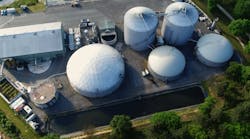
Implementing the system involved excavating a 15-acre, 18-foot-deep, flat-bottomed pond adjacent to the building; the pond serves as the heat sink/source for the geothermal heat pumps. The system is the largest hospital geothermal system in the United States, and the pond is the largest heat-exchange pond in the world. It includes 171 submerged loops of 1-inch HDPE pipe supported on cribs.
All told, the loops contain 152 miles of heat-exchange pipe. Flowing throughout the system is an 80/20 solution of water and methyl alcohol, which is intended to prevent freezing if a loop is taken out of circulating service. Each of the 171 loops is independently valved in the facility’s “manifold room,” where the loops empty into circulating fluid manifolds that serve the building’s heat pumps.
According to Diehl, if the Great River Medical Center in West Burlington, IA, that inspired Sherman Hospital’s geothermal heating system is any guide, the system should save the new hospital about $1 million in energy costs annually. “The pond has an HVAC capacity of 3,400 tons, and we currently are using 2,250 tons, so we have lots of room for expansion,” says Diehl. “For example, the monthly natural gas bills were significantly lower than in the old building, despite the fact that the new building is much larger. If the plant follows the example set by the Great River Medical Center in Iowa, the energy bills will be dramatically lower across the board.”
Of the 255 patient rooms, 224 are served with individual Mammoth Model N Vintage water-to-air heat pumps that supply both heating and cooling. The units are typically 3/4-ton (9,000-Btuh) capacity. The conditioned air supplied to each room is blended with ventilation air. Another 540 Mammoth model N Vintage horizontal water-to-air units are located in ceiling spaces in corridors, nursing centers, and other areas throughout the hospital. Although it is not the primary system for the emergency room and critical care areas, this system does provide reheat for the units that serve these areas.
The Governair air handlers provide filtered, conditioned air to various administrative areas in the hospital, as well as providing conditioned ventilation air for the local heat pumps serving the rest of the building.
David Harris, Governair’s director of sales, notes that the air handlers’ rooftop location offers two benefits. “Firstly, space,” he says. “New hospitals often must house more medical equipment and interior space used for mechanical plant takes away from this.
“Secondly,” he continues, “having equipment on the roof allows units to be closer to the area they are serving, which holds down installation costs. Also, the equipment can be ordered and delivered later in the contract, which spreads out the financial outlay.”
School Beta-Tests Green Technologies
Another recent HVAC system upgrade project using alternative fuel sources is the T.C. Williams High School Minnie Howard Campus in Alexandria, VA, which is designed for ninth-grade students. In 2008, Alexandria City Public Schools hired the Leesburg, VA, offices of Hayes Large Architects LLP and B2E Consulting Engineers to help turn the school campus into a laboratory for testing green building technologies that could be implemented throughout the school system.
The design team developed a combination of solar and ground source geothermal energy to significantly lower heating and cooling costs. Other energy-saving equipment includes a water-source Variable Refrigerant Flow (VRF) zoning HVAC system to simultaneously cool and heat the building, water source heat pumps, solar heat exchangers, low-flow plumbing fixtures, and tubular skylights to provide daylighting to classrooms, corridors, and bathrooms.
B2E hired Mitsubishi Electric Cooling and Heating Solutions, Suwanee, GA, which markets VRF zoning and split-zoning air-conditioning systems for commercial and residential installations. The company determined that new Mitsubishi Electric water-source W-Series units would physically fit into the tight spaces in the mechanical room and that the Mitsubishi Electric VRF zoning technology would meet B2E’s efficiency and sustainability objectives.
For solar power, 42 collector panels were placed on the front of the school. The panels provide active solar water heating and serve as a sun shade, reducing glare and cooling costs. Also, starting in April 2009, a field of 60 wells was drilled 300 feet beneath the school parking lot for the new geothermal system.
General contractor Caldwell and Santmyer Inc., Berryville, VA, first removed the 50-year-old HVAC system that included two locomotive-sized boilers and chillers. Shapiro & Duncan Inc., Rockville, MD, then installed the six Mitsubishi Electric water-source VRF zoning units. Shapiro & Duncan also set up the complex plumbing network that connected 8,000 feet of piping, which joined the closed-loop geothermal water system to the six WR2-Series Inverter-driven units.
The anticipated payback period for the W-Series units is five years, and the VRF system is expected to reduce energy costs by about 29% annually—$1.6 million compared with about $2.25 million for the old system. Even greater annual maintenance cost savings, as a percentage, are anticipated: about $60,000 for the new system versus about $222,000 for the old one, or about 73% less.
Chris Ott, project manager for Shapiro & Duncan, is impressed with the HVAC system upgrade.
“It’s an ingenious bit of green engineering,” he contends. “The school went from an antiquated chiller that was keeping water at 40 degrees and two huge, inefficient boilers maintaining 180-degree water all the time—even if it wasn’t needed—to a variable-speed condensing unit coupled to a geothermal well system that only runs if an indoor air handler needs cooling or heating. Add to this the ability to cool and heat simultaneously and to zone with multiple condensing units—those were other energy-saving milestones.”
Author's Bio:
Don Talend specializes in covering sustainability, technology, and innovation.
|
Advertisement]