



Soaring Energy Bills Put One Customer on a Power Trip to Make Its Own
After California's 2000 energy crisis abated, many businesses started to contemplate energy conservation more seriously—and began the search for an alternative power supply.
Friday, October 31, 2003
By David Engle
California's energy crisis in 2000 brought some nerve-wracking weeks to the management of the Atrium Hotel at Orange County Airport. Like millions of utility customers, this comfortable 200-room property faced a daily roulette game of rolling blackouts; meanwhile, the power utilities seemed to reap jackpots from skyrocketing invoices, some of them doubling and even tripling in a few months.
|

|
That energy crisis subsided, but not the higher rates, and the unpleasant aftertaste spurred many businesses to think more seriously about energy conservation—and to start looking for an alternative power supply. At the Atrium Hotel this effort culminated in autumn 2003 with the impending installation of three advanced technology microturbines for cogenerating heating and power. The new system, scheduled to go on-line in late September, will yield all the hot water and room heat the hotel guests can use, with ample to spare. Better still, the high-efficiency microturbines will cut the Atrium's electric bill in half; first-year savings are projected at a whopping $195,000. After subtracting the cost of the additional fuel needed for the generator and adding the value of this "recyclable" heat, the net gain still will come to perhaps $139,000. The break-even point on this investment likely will arrive in about two and a half years. Even that rapid payback will be accelerated and sweetened considerably with this fall's arrival of a fat, six-figure rebate check from the California Public Utility Commission's Self-Generation Program; it will show up in the mail shortly after the switch is flipped.
The three 60-kW generators on order from Capstone Turbine Corporation (www.microturbine.com) of Chatsworth, CA, boast a track record of reliable performance based on 2,500-plus units shipped worldwide, producing 4.4 million–plus documented hours of operation. So impressed was Atrium Hotel Owner Michael Wang with this straightforward cost-benefit payout that he eagerly inked the contract within just weeks of hearing the offer. Here's an overview of what Wang saw during the selection process and why he jumped on it so quickly.
Cogen: The No-Brainer
Wang's Atrium Hotel has been buying its power from Southern California Edison and getting its natural gas from the Southern California Gas Company. The latter delivers fuel to heat two 1.1 million–Btu boilers providing hot water and a 1.8 million–Btu boiler heating the rooms. Thus, energy conservation and efficiency are obviously top priorities.
Moreover, another business crisis hit United States hoteliers in 2001-2002 with the collapse of airline travel after the 9/11 disaster; belt-tightening became even more critical. Wang (who was traveling when we attempted to reach him for this story) met with friend Mark Rhee, who has strong credentials in the energy-services industry, and the two began exploring money-saving options. Rhee noted that the volume of gas the Atrium was burning—between 76,000 and 83,000 therms per year, costing more than $40,000—made the establishment a prime candidate for electrical cogeneration (the gas burned for heating water or air is first shunted to drive a turbine and generate power). The result, once the turbine is paid for, is effectively "free" electricity. Rhee also knew that such cogen systems currently qualify for a hefty Utility Commission rebate. Given this virtually guaranteed investment opportunity, the decision to go ahead became, as Rhee observed, "a no-brainer."
Blackout Insurance?
But could the turbines also provide emergency backup power as a hedge against future outages? Rhee (now operating an energy services company called Leading Edge Energy) invited Capstone Turbine's local dealer, Nick Grill of Terawatt Inc. in Helendale, CA, for an analysis. Grill reported that, indeed, "backup/cogeneration" was feasible. After further cost studies and a survey of the Atrium site, however, it was determined that the expense and complexity of a dual-function system would be much greater. Additional switching hardware and several hundred feet of piping for power and water lines "might have added 40 or 50% more cost to the project," Grill recalls. In addition, the all-important rebate might conceivably have been jeopardized. Wang and Rhee thus decided to focus only on the cogeneration opportunity, discarding the backup-supply concept for now. "We could have done it," Grill says of this functionality, "but it would not have been done easily." The simple cogeneration plan, however, "worked out very easily."
Grill and Rhee next drafted a proposal for Wang to consider, making sure, as Rhee recalls, "that we achieved the correct deferred calculations for waste heat recovery … and making sure the numbers were all OK and that the return on investment was good." He presented several financing options so that Wang could easily make the call.
Running Numbers With an Energy Manager
Conceptually, cogeneration is a no-brainer, but even so, the precise impact of the free power had to be calculated for budgeting and planning, for the rebate application, and to ensure that day-to-day operations would fully maximize the cost-savings benefit. One key to making the analysis was Rhee's suggestion that the Atrium enroll in a service offered by Southern California Edison called EnergyManager (www.sce.com/sceenergymanager). For a nominal monthly fee, customers can obtain detailed power usage and billing information, such as the variable per-kilowatt rates during peak versus off-peak hours and per-kilowatt demand fees. EnergyManager, which is similar to tracking services offered by numerous utilities nationwide, offers a range of service tiers—e.g., EnergyManager Basic, Cost Manager, and Bill Manager accounts, as well as some degree of industry-specific customization. Rhee describes how its reports help cost-justify a cogen plant: "Usage and expenses can be mapped to time of day or viewed in aggregate blocks over set time periods." The reports provide more refinement and specificity than is available to customers reading a basic no-frills statement. In using EnergyManager initially, he recalls, "We looked at historical energy bills for the past year, and then we did kind of an 80% rough estimate on what these microturbines could do to save [Wang] money." The two then went back to obtain even more specific data to fine-tune the projections. "It was like, ‘Let's take a look at it, print out last year's detail, and then see this month's detail," he explains.
Atrium General Manager Sheri Blackwood also became involved in budget projections at an early stage, working up various scenarios on how power costs would be impacted by cogen turbines and how the hotel's load on them would look on a daily, weekly, and monthly basis. Using this very promising data, she remembers, "Right away we started shooting the numbers to see what type of investment it would take and what the ROI [return on investment] would turn out to be."

One major discovery to emerge was that the cogen system should certainly run during all peak rate and demand hours (those being, obviously, mornings and certain spike periods in the afternoons). Likewise, the system turbine could be cut back during off-peak hours when rates drop in the early morning. "This turned out to be much more cost-efficient than running 24/7," Blackwood notes.
Grill also found that the Atrium's peak load was running at about 340 kWh; turning on the turbines could halve this to about 170 kWh. On an averaged per-kilowatt-hour basis, this would drop the cost from about 13.5 cents to only 3 or 4. Or, to put it in terms of wattage dollars, the cogen system is projected to yield about $6 worth of power for every dollar spent on natural gas—a fuel that, again, was being purchased in quantity by the hotel anyway.
In case you're wondering, similar reduction ratios might be achievable on an almost limitless array of cogen projects wherever natural gas or propane is being burned for heat. Of course, the specifics on how this might occur would depend on local circumstances; customized calculations are always required. When you're looking for guidance on "what-if" scenarios, your turbine dealer should be able to provide case histories from a good cross section of installed projects in comparable industries. One key element that tends to make a proposed project more likely to maximize its gains is a 24-hour load for both electricity and heat; this was true in the Atrium Hotel's case, but it might not be so in, say, a manufacturing plant running only one shift.
Because the guests' hot-water usage fluctuates throughout the day and night and varies with occupancy levels, the proposed cogen turbines sometimes will end up producing more hot water than is actually needed. The excess heat will then be diverted and ducted out as exhaust. An even better alternative: The latest generation of Capstone microturbines with integrated heat recovery can be programmed to sustain a specified heat output and not exceed it. Controls can also be set for a specified electrical output. By contrast, according to Grill, earlier turbine designs tended to run at full throttle a bit wastefully. By having programmable controls, you can match specific electrical and/or thermal load demand in real time. Having this flexible choice between "load following" and "thermal following," Grill observes, is really critical to efficiency and is one of the major technical advances of the Capstone CHP product line, which began shipping in mid-2003.
One potential negative in the conversion—at least on paper—is the system's reliance on natural gas. What will happen if prices double or triple the way grid power did just awhile back? Historically fuel prices have jumped around. (In mid-2003, rates were hovering around 56 cents per therm.) Even so, as Grill points out, cogeneration will always make sense because a hotel must always heat its water regardless of the cost, and the heat can always be leveraged to make "free," more valuable cogen power. In addition, even if natural-gas prices "should soar through the roof someday," as Grill notes, this rise would be reflected in utility kilowatt costs, thus making the value of in-house cogeneration even greater.
Net Savings
As Rhee and his construction subcontractor Grill now sorted through the options and began custom-designing a system, the overriding goal, as Grill recalls, was to make "the biggest possible impact on electrical costs while staying within the cogeneration efficiency parameters" defined by the rebate program. The Utility Commission rewards efficient reuse of existing heat to produce power, up to 30% of the project cost.
With this in mind, Grill and Rhee laid out a plan for installing three 60-kW Capstone microturbines. The initial capital outlay looked like this:
Total cost of three turbines, installed: $337,763
Rebate, projected: $101,329
Net out-of-pocket cost: $236,434
Estimating the ROI, their figures came out as follows, based on current 2003 electricity bills:
Estimated cost of electricity without cogeneration = $288,000
Projected annual electrical savings via cogeneration = (-)$198,000
Net cost of purchased power after cogeneration = $90,000
Estimated cost of additional natural gas = (-)$102,000
Net savings ($198,000 – $102,000) = $96,000
Value of the additional heat = $43,000
Net first-year advantage with cogeneration ($96,000 + $43,000 ) = $139,000
Again, the outright savings on electrical cost came to better than 30%. Blackwood, for budgeting purposes, figured more cautiously by anticipating only a 20% savings; this also factored in the possibility of reduced room occupancy during the economic downturn. Regardless of which scenario she assumed, though, a decent ROI emerged. Even with her conservative assumptions, if the turbines save only 20% on grid power expenses, the installation, with a rebate, will pay for itself within two years—"which makes total sense," she observes, "when you're looking at historical data for how much our utilities have been increasing over the course of the years."
Weighing against the go-ahead decision, however, was the fact that Wang was also budgeting $1.5 million in 2003 on renovations. Ordinarily, scheduling two major capital expenditures in the same year wouldn't happen—one or the other would be deferred. On this theory, the cogeneration plant investment was initially budgeted for 2004, but when Wang saw how compelling the numbers were, he and Blackwood both agreed that the risk factors were minimal. "It made such perfect sense. We decided to put it in this year," she recalls, and they moved quickly to accept Rhee's proposal. "We're not typically like that," she adds. "But it was a no-brainer."
More Considerations
Amidst these financial considerations, a few other questions needed resolution. First, are turbines noisy? How would their presence impact guest comfort? From her previous hotel experiences, Blackwood knew that diesel generators can indeed sound like pedal-to-the-metal truck engines; at one property, a few guests had complained about the noise even five or six floors up. Blackwood liked the cleaner and smaller profile of the proposed natural-gas–burning turbines. The Capstone brand that Rhee was recommending even came with a frictionless "air bearing," so no oil or lubricants would ever be needed, and all three turbines would come self-encased for outdoors installation.
|

|
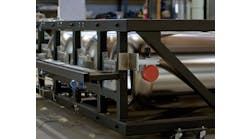
All of this was reassuring, but nevertheless, in order to see a turbine in action, Wang was escorted to a nearby furniture manufacturer using the clean, contaminant-free exhaust of cogen turbines in a finishing process; this heat was being harnessed effectively, while power generated on-site cut the factory's power bills. Impressive as well was the surprisingly small turbine cabinet Wang found there (H: 94 in., W: 30 in., D: 77 in.). The rapid air intake sounded like a vacuum cleaner, a tolerable noise level if the turbine is positioned somewhat remotely and run mostly during the peak (daytime) hours.
A second issue: What would happen if the gas turbines should grossly underperform? Capstone's director of communications, Keith Field, replied to this concern by pointing to the consistent performance data the company has collected from extensive field operations. Turbines running daily have proven far more reliable than generators used intermittently as backups. In the field, Capstone's 30- and 60-kW engines "have proven to be very robust," says Field, as several of the company's earliest installed systems have racked up more than 30,000 hours of near-constant operation. He adds that because they have only one moving part and need no lubricants or coolants, the systems require little more than a few filter changes and injector cleanings. There's very little that can go wrong with them. Nevertheless, the contract guarantees certain performance levels.
Onsite Engineering, Installation
More challenging, perhaps, were several engineering questions. Where and how, for example, should the turbines be positioned: at ground level, belowground, or perhaps on the rooftop? Installations are always custom-designed to tie together assorted boilers, storage tanks, and electrical panels, Grill notes. Placing the microturbines on the ground was initially considered (the Atrium has no basements) but was discounted in favor of the rooftop. Resulting noise output there might be hard to predict, but rooftops usually are the preferred locations for other big equipment, such as cooling towers.
Connection circuitry—water and electrical piping—will tie the cogen turbines to a particular storage tank; instead of a boiler heating it, the cogen system will. Grill explains, "We're actually just piggybacking onto something they already have, so if the turbine goes down, their main system will still operate. They'll have some redundancies in there." To connect the turbine to the hotel's power grid, Grill will install a subpanel and circuit breakers.
Each cogen unit literally weighs a ton, so this burden must be distributed to load-bearing walls and footings by wood beams (4 x 14 in.) underneath. From this position, 2- and 3-in.-diameter conduits will run down the side of the building, about 100 ft., to ground-level machine rooms and storage tanks; a chase will cover the piping for aesthetics.
Rooftop installation will require a crane to set the turbines on their pads. Commissioning will consist of simply connecting water lines almost as easily as attaching faucet hoses to new laundry equipment and plugging them in, says Grill. Electronics for regulating temperature and water flow and assuring systemwide compatibility are already built in. "Voltage," he points out, "is synchronized to feed the turbine power back into the grid. It basically mirrors [grid conditions] and then pushes power back into that." At startup, a few local conditions are programmed in by the installer. "And that's basically it," he says. "Turn it on and let it go." Adjustments, if needed, can be performed by the Atrium's maintenance engineers heeding the owner's manual. Control panels on each unit can direct the whole array; remote-control access is also possible via modem or an optional Internet connection.
As of late August, building permits hadn't yet been OK'd, but their approval was expected imminently. Turbine projects get cleared eventually, but it's not unusual for building department clerks to scratch their heads in some bewilderment when seeing specs for a cogen project.
As for complying with Air Quality Management District rules, turbines usually get rubber-stamp approval, as they burn far more cleanly than do most existing boilers. The manufacturers' documentation carries all the necessary emissions certificates to prove it.
The hotel's new turbines might well have been on-line by Labor Day—just three months or so from the date of Rhee's initial proposal—but for the very slow rebate application process. Doing business with the power company has been, on the whole, rather paperwork-intensive and sluggish, Grill notes. Conversely, Southern California Gas (which ultimately stands to gain a much more lucrative customer from all this) has been helpful and responsive.
Despite the sometimes frustrating rebate hurdles, Blackwood sums up the overall cogeneration quest as "a very seamless process for us." Most remarkable has been the quickness of the whole process with natural-gas turbines compared with two previous diesel projects she'd seen elsewhere; the latter required up to two years to plan, explore, and carry through. By comparison, in just four short months, she says, "We were able to get all the information we needed with confidence. We were able to put down the deposit and sign the contract—and to say, ‘Let's move forward.'"
Author's Bio: Writer David Engle specializes in construction-related topics. |
Advertisement]