

Two Backup Generators Are Better Than One, Dairy Finds
The milkmaid of America's agrarian past is long gone, replaced by automated machinery that depends on reliable power.
Sunday, October 31, 2004
By George Leposky
Most milking in America now takes place on modern dairy farms that are highly automated factories, efficiently extracting their product from hundreds or even thousands of cows on a rigorous twice-a-day schedule. Any significant disruption of that schedule causes the volume of milk the cows produce to shrink—and that shrinkage goes straight to the dairy's bottom line.
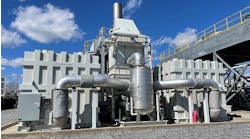
Electricity is vital to the operation of a modern dairy farm such as Shamrock Farms' new milk-harvesting facility in Stanfield, AZ. To help keep its "assembly line" going without a hitch when utility power at Stanfield fails, Shamrock turns to standby power from a 750-kilowatt Gemini Twin Pack diesel generator set from Generac Power Systems Inc. of Waukesha, WI.
The Gemini Twin Pack consists of two 375-kilowatt generators, running in parallel, housed within a single enclosure. Integrated controls combine the output of both generators in normal operation, or allow either to back up the other so the milking parlor's most critical energy-consuming functions can continue even if only one of the generators is operational.
Responding to Growth
Shamrock Farms, founded in 1922, is the largest dairy in the Southwest under family ownership and operation. It produces and distributes a full line of dairy products to major grocery chains, schools, hospitals, and institutions.
To meet the growing demand of Arizona's burgeoning population, Shamrock has been expanding. In 2003 it replaced an older, smaller farm in Gilbert, AZ, with the new Stanfield facility. Located 52 miles south of Phoenix, the Stanfield farm has more extensive shade structures to shelter the cows' feeding and resting areas from the intense desert sun.
Shamrock owns about 1,000 acres at Stanfield, of which the dairy farm occupies 240 acres. The rest is leased to growers of alfalfa, corn, and cotton. The new dairy farm took nine months to build. It opened May 16, 2003.
Although Shamrock maintains a small herd of registered Guernseys at Stanfield, most of the farm's cows are Holsteins, a breed known for its prodigious milk production. Frank Boyce, a Shamrock Farms vice president who is general manager of the Stanfield facility, says the entire bovine population there numbers 15,000–8,500 cows, of which 7,000 are being milked at any given time; and 6,500 calves and heifers under two years of age.
The animals are on a reproductive cycle that ideally results in a calf every 13 months and allows for 11 months of milk production. "Cows have a nine-month gestation cycle," Boyce explains. "During a 60-day post-partum period, we don't allow them to breed. Then we start breeding them again. The ones that get pregnant right away will milk for 11 months, dry off for two months, then get pregnant again." A computer database stores detailed records of each cow's reproductive and milk-production history.
A High-Tech Operation
The milking parlor, an open-sided barn, has four milking lines. Each accommodates 50 cows every 15 minutes. Each cow gets milked twice a day, at the same time each day. "The first time we take a cow to the barn, she stays on that schedule," Boyce says.
As the cows stroll into the milking parlor and take their places, workers on a sunken walkway connect a milking unit to each cow's teats. Instead of milkmaids' fingers, a pulsation system expands and contracts a rubber inflation liner around each teat to squeeze out the milk. Two 35-horsepower pumps create a vacuum that sucks away the milk through stainless-steel pipes. It goes to a receiving tank, then to a plate heat exchanger for cooling from 100°F to 36°F, and finally to three 15,000-gallon storage silos to await transfer into a tanker truck.
"We milk close to 800 cows an hour," Boyce says. "It takes us almost nine hours to milk 7,000 cows. In summer they produce an average of 65 pounds of milk per head per day, in winter about 70 pounds per head per day. That's a total of about 450,000 pounds [roughly 52,325 gallons] of milk a day in summer, and about 500,000 pounds [roughly 58,140 gallons] a day in winter. We ship nine tanker loads a day in summer, 10 in winter, to the main dairy processing plant in Phoenix."
Around the Clock
Milking cows is a 24-hour, seven-day-a-week job, Boyce emphasizes. "It's important to milk them on the same schedule every day," he says. "If you lose electric power, you can't milk the cows, and that's detrimental to their lactation cycle. If you don't milk the cows, if you get too far behind, you're telling the cow that her need to generate milk isn't as great as it used to be, so she cuts back on the amount of milk she gives. You can't get that lost milk back.
"If we get off schedule by an hour or two, we try to speed up the whole process. After three hours we usually don't catch up. We get farther behind, and then start all over, so one group of cows won't get milked the second time that day.
"The loss amounts to a pound or two of milk per head per day. If you figure the loss at 1.5 pounds times 7,000 cows, that's 10,500 pounds a day or 315,000 pounds a month, which in dollar terms represents a loss of about $37,800 a month. We don't want to have that happen."
Inconsistent Power Supplies
The small rural utility serving the Stanfield dairy farm, Electrical District 3, is a distribution system with no generating capacity; it buys all of its power from other suppliers. "We've experienced some inconsistent power supplies," Boyce says politely.
"Shamrock Farms is in a grid-distressed area, far away from the nearest substation," explains Lee Sundquist, project manager at Arizona Generator Technology in Glendale, AZ. The firm, which does business as Gen-Tech, is the Generac dealer serving Arizona and the Southwest.
The risk of power outages at Shamrock's Stanfield dairy farm is greatest during Arizona's summer monsoon season. From late June through September, high pressure in the Gulf of Mexico spawns southeasterly winds that transport humid air into the desert. The sun's heat warms this moist air, causing it to rise. As it climbs the slopes of the surrounding mountains, it cools and forms billowing cumulonimbus clouds that can unleash violent afternoon and evening thunderstorms.
At other times of year, utility power at Stanfield is relatively stable, with only two or three outages of a few hours' duration. During the monsoon season, however, the farm loses power as frequently as once a week.

Backup Is Critical
In its first 16 months of operation, the Stanfield farm sustained 30 utility-power outages, including one that lasted four hours. "The backup generators kicked on and we kept milking. If we hadn't had them, it would have been detrimental to the cows," Boyce says. The generators run the milking parlor's lights, milking machines, vacuum pumps, and the cooling system for the milk.
"There are five electrical services on this job site," says Dave Bennick, general manager of the farm's electrical contractor, DeLaval Direct Distribution in Chandler, AZ. "The milking parlor is the only one driven by this Gemini generator set." The others—serving a hospital barn, the feed-handling area, and two separate air-conditioning systems that help keep the cows cool—lack backup power because they don't really need it.
Nothing else on the farm is as critical as the milking parlor, Boyce insists, not even the water supply. A cow drinks about 30 gallons of water a day, a heifer about 15 gallons a day. Gravity flow from a 500,000-gallon storage tank keeps the cows' water troughs full. A 400-horsepower pump draws 1,800 gallons of water a minute from the farm's well into the storage tank, which holds a little over a day's supply. "We have a generator hookup for the water pump, so we could rent a portable generator if necessary," Boyce says.
When Utility Power Fails
The Gemini Twin Pack consists of two identical generator sets—each a 12-liter engine from Mitsubishi Heavy Industries Ltd. connected to a 375-kilowatt alternator made by Generac. Each generator set has its own mainline circuit breaker and a downstream control panel housing a 1,000-amp contactor connected to a transfer switch in a service closet inside the building.
Utility power comes in from the power pole, goes through the meter and a main circuit breaker, and enters the transfer switch, which "knows" to look for power. It has a small relay held open by utility power. A failure of utility power closes that relay, making the contacts that start the generators.
"When utility power fails, the signal is sent to the generator sets to start, run, and come up to speed," Sundquist explains. "The first generator set that is up to speed and voltage will close its contactor first. The second generator set will parallel with the first and then close its contactor, sending a signal to the transfer switch: 'We're ready to go on load.' Then the transfer switch rolls to its alternate position, connecting the generator set to the building load and accepting the load, and the lights come back on."
The startup sequence employs two timers:
-
A time-delay start timer to prevent nuisance blips in the utility power from triggering a startup
-
A transfer-delay neutral timer that allows large motors included in the facility load to wind down so the backup generator doesn't connect with them out of phase
Sundquist says most applications use a five-second setting for each timer, but "a few extra seconds won't bother the cows. The lights flicker for 10 or 20 seconds, long enough for motors to have to be restarted, but the motors in this very modern plant have automatic restarters."
When Utility Power Returns
Restoration of utility power opens the relay at the transfer switch, starting another sequence of timers to shut down the backup system:
-
A return-to-utility timer delays the shutdown long enough to ensure that the utility power is stable. This timer can be adjusted from five seconds to three minutes. Sundquist says it's usually set at about two minutes.
-
A minimum-run timer keeps the generators running for an optimal duration, even if utility power was restored prior to that time. "The generators are better off to run long enough for their temperature to stabilize, rather than shut them down too quickly," Sundquist explains. "The minimum run timer is adjustable from five minutes to 30 minutes, and is usually set at 15 minutes."
-
A cool-down timer. "After the transfer switch returns power to the utility, you don't want to shut off a hot engine, so to cool it down you run it for five minutes at full rpm but no load," Sundquist says.
"The engine does not cool well at idle, and there are several other reasons not to idle the engine.
"At idle, the oil pump and water pump of the typical engine have such a reduced capacity that the risk of overheating and oil pressure that is too low may be damaging to the engine. Also, whenever the rpm slows down, the voltage regulator attempts to maintain full voltage. If the rpm is too low, the voltage regulator gets overstressed by trying to do the impossible. Some generator sets have circuitry to disable the voltage regulator when the rpm is too low, but cooling down the engine at full rpm and no load is a better scenario."
Air flow through the engine at full rpm and no load also aids in the cooling process, Sundquist says. Air drawn in through the eaves of the enclosure passes across the two engines in opposite directions and through their radiators, then exits vertically in the center of the enclosure.
Brownout Protection
If the flow of utility power falls below a pre-specified percentage of its normal level (adjustable between 75% and 90%), the Gemini Twin Pack will start and provide brownout protection. It will shut down only when the utility power resumes an acceptable percentage of normal flow.
"The utility usually drops completely, negating this dropout requirement, but during a brownout the dropout and return voltage adjustments would be very important," Sundquist says.
"Having the voltage ever be as low as 80% would likely be very injurious to a facility's electric motors, and one would not want to go back to utility power after a brownout until the voltage had stabilized at near 95%."
Why Two Engines?
Sundquist says the major benefit of the two engines in the Gemini Twin Pack over a single engine is a 25% reduction in capital investment cost.
"There is also a slight advantage in the ability of the two 375-kilowatt generator sets compared to a single unit when it comes to motor starting," he adds. The alternator on each generator set is rated at 400 kilowatts, whereas a single 750-kilowatt generator set would require an 800-kilowatt alternator. "With the two engines, you'll have a slightly better startup," Sundquist says. "The governors can respond faster to the inertia in the engines."
He explains that the two units operate in parallel by comparing voltage and speed. Isochronous governors count the teeth on the flywheels and turn that count into a reference voltage, within a specified window of acceptability. It won't be exactly 60 hertz, but it's close enough so the synchronizer recognizes the similarity and closes the contact for the first generator set. Then the second unit parallels with the first. Sometimes one unit connects first, sometimes the other. It's a random event.
Author's Bio: George Leposky is a science and technology writer based in Miami, FL. |
Advertisement]