
Onsite Power Glows in Brooklyn
Two food-processing operations in Brooklyn, NY, take different approaches to getting their combined heat and power operations up-and-running.
Wednesday, June 30, 2004
By Penelope B Grenoble
Wayne Celauro, vice president of privately owned 4C Foods Corporation was fed up with the high price of gas and electricity at the company's food processing facility in Brooklyn, NY. "It's a way of life," says Celauro. "You pay big gas bills, you pay big electric bills, and you try and make it. But the alternative, to generate our own power, never seemed to make sense."
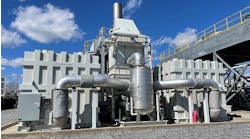
Then came clean-burning gas engines, and Celauro began to investigate the feasibility of what he previously thought was impractical. Although he has an engineering background, Celauro was immediately overwhelmed with sorting through conflicting claims from vendors and manufacturers and initially sought advice from his local natural gas supplier. Finally he hired Energy Concepts Engineering in Rochester, NY, an engineering consulting firm that designed what President Bill Cristofaro calls a classic combined heat and power (CHP) installation, which includes two 150-kilowatt and one 80-kilowatt Coast Intelligen natural gas cogeneration units and uses waste heat recovered off the engine and the exhaust for building heat and for process heat to dry cheese 4C Foods packages and for two Yazaki Energy Corporation 20-ton absorption chillers for building air conditioning.
"Cogen systems are all the same until you go to use what they give you," says Cristofaro, "and 95% of the failures in cogen plants fall into two categories: The first is poor application to the site - the failure to use the power and heat effectively. The second is lack of a maintenance and warranty contract."
"We're a privately held company," says Celauro. "So it's not so much that I needed a three-year payback or something along those lines in order to justify the project. What we were looking for was long-term savings. And even if it seemed at first that we were stretching the limits in generating our own power, it also began to look like a very interesting project. I liked the idea that you can reuse the waste heat. And in addition to saving money, I liked the idea that we're doing something constructive. The next step was to figure out how to make this work."
Down to Basics
To begin the process of making things work, Energy Concepts ran a spreadsheet based on 4C Foods' existing electric baseline and gas usethermal baseline and then plugged in a hypothetical CHP plant to see how much power and heat could be generated to meet these existing loads. "The spreadsheet takes into consideration all factors that would influence the cost of generating onsite electricity at this particular facility," says Cristofaro, "the fuel into the plant, the power and heat produced, emissions calculations, and the effects of the standby tariff. We also included a full maintenance and warranty insurance policy on the cogen units, which is a must on every plant we design. One thing to keep in mind is that the construction estimate will vary in proportion to the size of the plant, which means if you make the size of the facility too large, the construction cost will rise accordingly and savings will drop and your payback will be lost. We believe you can make an onsite power plant too big but you can't make it too small up to a certain minimum size."
In the case of 4C Foods, which opted to self-finance the plant Energy Concepts designed, a $500,000 CHP incentive grant from the New York State Energy Research and Development Authority cut the out-of-pocket cost of installing the plant nearly in half, and this tipped the decision-making scales for Celauro. Instead of the four-year payback he was originally looking at, the grant also helped cut that time in half. But the project hit a snag when the facility Energy Concepts designed went over budget because of high labor costs in the New York City market and requirements made by the utility, which thwarted plans to combine two existing services into one. Energy Concepts then modified the design to run the cogen plant as combined for heat recovery but split the units electrically to serve separate services. The final design called for three gensets to supply about 80% of the facility's power while the grid provides backup. Celauro says he never considered running completely independent of the utility because he says he wanted the security that power would always be available.
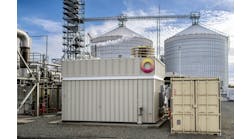
To help keep the project alive when costs threatened to close it down, Energy Concepts brought in New York and California-based Coast Intelligen Inc., which markets modular CHP systems. Coast Intelligen was able to deliver one of its prepackaged systems, which brought down the cost of installation and put Celauro's plant back on track. "Our primary product is prepackaging cogeneration systems," says Coast Intelligen President David Lesser. "We have a standardized platform and do much of the work in the factory that would typically be done in the field. This speeds up delivery time and brings down the overall cost. In the case of 4C Foods, we supplied three prepackaged cogen units, which included the engines, the generators, and the heat recovery system plus the control system. We assembled these prepackaged units in a standard 40-foot shipping container and shipped it by truck from our factory in California to New York where the client situated it in an existing parking lot." Lesser also notes that sound attenuation was a goal, given where the units are located, and he says the container was soundproof so the engines are "quieter than the passing traffic."
Rounding Out the Installation
Yazaki Energy Systems based in Dallas, TX, provided 4C Foods with two 20-ton hot-water-fired absorption chillers. The Yazaki product, which uses lithium bromide, combined with the clean-burning gas engines makes the installation even more environmentally friendly. The frosting on the cake was an incentive from the local gas supplier, which Celauro estimates will cut his gas costs by as much as 50%.
"Did I take a big leap of faith? Certainly, but sometimes you have to do these kinds of things to get where you want to go. And it helped to have the state's money behind us. Would I do it the same way again with an outside engineer? Absolutely. Relying on someone who is expert in the field rather than trying to deal with vendors and equipment suppliers evens the playing field. It was important to be able to talk to Energy Concepts about why a particular product was best suited to me and what its downside might be for the type of operation I have and where it's located."
At Energy Concepts, Cristofaro says it was never part of the project's economic prospectus that 4C Foods would sell power back to the grid. "First of all, the company needs all the power it will generate, and second, the project is too small. In New York State, power has to be sold back to the utility or the New York State ISO [Independent System Operator] in 1,000-kilowatt blocks. Some of the plants we've installed have the controls and devices to be able to sell power back, so it's something that's technically possible, but contractually and approval-wise, most operators use most of the power on-site. Although selling back to the grid may make business sense, we're still sorting out the economics. For an induction plant to sell power back to the utility is not that complex because an induction generator will go down instantly as soon as the utility loses power. This reduces the threat of power feedback for linemen working on the lines, but it's no good if you want your machines to pick up the load if the utility fails."

Going It Alone
In contrast to 4C Foods' partnership with Engineering Concepts, there was never any question that Tom Spencer, technical services director at Ahava Food Corporation, would go it alone. His can-do attitude reflects the company's philosophy of thinking outside the box. Looking for a place to expand its cold food storage facility, Ahava bought and renovated an abandoned sugar warehouse in the Red Hook section of Brooklyn. From the start, Spencer knew he wanted to island the onsite plant he planned to power the facility. "When we bought the city block, it had been abandoned for years, and there wasn't anywhere near enough power available to satisfy our needs. Con Ed had taken out its equipment and rerouted its power elsewhere. The utility would have had to put in new service cables and we would have had to put in all new service entrances. And both would have been expensive."
|

|
|

|
Before an onsite plant could be installed, the building had to be renovated, including the installation of a new roof at the cost of half a million dollars. Two hundred junked cars had to be removed from the parking lot, as did 1,000 tires with rims that someone dumped after Ahava removed the fences to dispose of the cars. Then came debates with the local preservationist commission, which didn't want the historic building altered, and protests from residents who didn't like the idea of a commercial facility in their residential neighborhood. But Spencer was undaunted. He rebuilt the roof to withstand loads from the equipment he planned to install and, as an engineer who once built power plants for the military, set out to locate the heavy-duty equipment he wanted, going as far as Texas to secure filters and other high-pressure gas equipment.
"We decided to put in half a million cubic feet of freezer space that would be maintained at —15° Fahrenheit," says Spencer. "We figured we'd use maybe 10% of that, and since there's a shortage of cold storage space in New York City, especially close in, this would pay the rent. And once we got it up and running, it has. We also have a 490,000cubic foot cooler. To purchase the property, we floated a bond issue underwritten by the Industrial Development Agency, and one of the provisions was that we provide some employment. So we put in a yogurt processing facility. So far we've provided some 60 jobs."
Spencer figured the average load to power the refrigeration, the yogurt operation, and the building heat and cooling at between 230 and 240 kilowatts. Besides the offices, there are also loading docks and the 14 delivery trucks that get plugged in every night. By the time he contacted Howard Goodman, owner of Rudox Engine and Equipment Company Inc. in Carlstadt, NJ, Spencer knew how much power he wanted and how he wanted to generate his electricity.
"Tom had determined what size engines he wanted within a certain range," says Goodman. "We put together an equipment package and told him what it was going to cost him to do what he wanted to do." What Goodman came up with was two lean-burn, natural-gas-fired, 500-kilowatt Mitsubishi continuous-duty-rated engines and one 800-kilowatt backup diesel. "If all three went down, there was also a fourth line of defense with switchgear that would allow the plant to make use of a portable diesel."
"We put in the second engine to be 100% redundant because we're off the grid," says Spencer. "Plus, we've got the diesel, which we can only run the equivalent of 30 days a year because of emissions regulations. We don't recuperate the exhaust off the engines, but we do off the jacket. Right now we're planning on building another 10,000-pallet freezer in the parking lot. So at that point we'll be using the exhaust. When that's completed, we'll have the biggest cold food storage in New York City." The Ahava gensets are located within the food storage building, and the mass of the building acts as a sound attenuator. Currently, exhaust from the engines gets thrown off through radiators located on the roof. "Initially when the radiators came on it sounded like a helicopter taking off," says Spencer, "so we installed variable-frequency drives. We wanted to run them at the absolute maximum speed necessary, which turns out to be 35 to 37% of their capability. This makes them much quieter."
A remote monitoring system lets Rudox crews check on the gensets daily. "As part of the system's reliability, we dial up the site every day and look at all the parameters of the engines. Recently we saw that one of the cylinder temperatures wasn't as good as it should be. We called the plant and told them to switch to the other unit until we could fix the problem."
Goodman figures Ahava Foods could run its entire operation on one of the gas gensets, which means that by conventional standards, the facility is grossly overpowered. But Spencer points out that he wanted first to be independent of the grid and second to be ready to meet his energy demands when he expands. And among islanded operations Spencer does not look so overpowered. "If you look around New York City at the power plants that were put in 20 to 30 years ago," says Goodman, "and which run independent of the grid, they usually have a lot of redundant power. The conventional wisdom is you don't ever want to be caught short." (Spencer points out that during the 2003 power blackout his was one of the few facilities around New York that was up and running.)
"We like to do projects like this where the owner decides what he wants and then makes value judgments. In a situation like this you're going to buy gas for years and years, so you're not just looking at the initial investment; you've got to look at life cycle costs. You have to make trade-offs between what you spend your money on today in terms of investment versus lower fuel consumption or lower maintenance costs and/or reliability down the road. If you get too cost conscious on the investment end of things, you end up trading off today's dollars for what you're going to spend in the future. In an installation like this you're going to spend 10 times the amount of money in gas over the next 20 years than you invest in machines. These kinds of trade-offs are the type of things that owners have to be prepared to make, and Ahava was very good at this."
Spencer estimates his investment in equipment at $1 million. If he hadn't done all the installation himself, he says the cost of the plant would have amounted to another million, which didn't make economic sense. He figures it's costing him about $0.017 per kilowatt to generate his electricity (about a fifth of what it would cost from the utility) and another $0.002 for maintenance. Initially, return on investment was estimated for 1.6 years, but higher gas prices have pushed it up to 2.5 years. "We're already at the break-even point," says Spencer, "but if we hadn't done it ourselves, we couldn't have afforded it, and if we hadn't been able to build an onsite plant, we wouldn't have been able to install a freezer.
|

|
"I've installed plants around the world. There was never a question I wouldn't do it myself. We did all the cabling and all the heavy electrical. Putting the plumbing in for heat recovery is what took the time. It's all 5-inch copper, sweated. We have about a mile of it running down the building dropping off at various points." Spencer estimates he spent $175,000 on installation using labor from allied Ahava operations.
Spencer also went directly to Steve Cohen at Yazaki Energy Systems for hot-water-fired chillers. He says he knew from the beginning he wanted to give this kind of hot-water-heated unit a try. Although Cohen was accustomed to working with engineering specifications, he got in the spirit of the job, did a quick load calculation, and concluded that Ahava office space would require about 30 tons of cooling capacity to be provided by three 10-ton Yazaki modular chillers. Another 20 tons were required to supply the 45°F water need for processing yogurt.
"The exhaust heats the water that will drive the chiller plant to approximately 1,900° Fahrenheit to 190° Fahrenheit in a heat exchanger," says Cohen. "Although the chillers could be installed indoors or out, given the V configuration of the building's roof, we opted to put them inside." Spencer says he was impressed by the Yazaki units "because they looked simple, without moving parts," and he has been extremely satisfied with their performance.
Among cost-saving strategies, Ahava enjoys a special rate from its local gas supplier because it agrees to shut down its gas engines and go on diesel when the outside air temperature drops to 27°F. "We run the diesel standby to supply our power - this gives us a chance to exercise the engine - and they route the gas somewhere else. It happened twice last year."
The Ahava onsite plant is in its third year of operation, and Spencer expects his engines to last a minimum of 10 years. Right now, he's considering another cogen plant for a milk processing facility the company has just purchased in upstate New York.
Author's Bio: Journalist Penelope Grenoble is a frequent contributor to Forester Media, Inc. publications. |
Advertisement]