
March-April 2004

Yale Campus Warms Up to Fuel Cell Technology

Yale University in conjunction with the Connecticut Clean Energy Fund look to hydrogen as a way to clean energy.

Article Tools

  • RSS
  • Save
  • Print
  • Email
Create a Link to this Article

Sunday, February 29, 2004

By Ed Ritchie

Comments

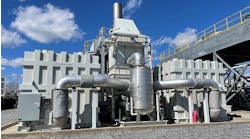
December 3, 2003, was a typically cold winter day on the Yale University campus, but below-freezing temperatures didn't stop Connecticut Governor John Rowland and a host of dignitaries from attending the dedication of the historical institution's first fuel cell. The 250-kW molten carbonate power plant from FuelCell Energy marks a high-profile achievement for both Yale and the Connecticut Clean Energy Fund (CCEF).

The university gets a working lab for integrating fuel-cell technology into its environmental programs, and CCEF, despite a cutback of funding, gains some valuable publicity to bolster its mission to promote energy from clean and renewable sources.

"One of our biggest challenges is funding," says Subhash Chandra, chief technology officer and managing director for CCEF. "In the past year the legislature threatened to take all of our funds, but a deal was negotiated, and we lost one-third of our funds for seven years. We have major political challenges in maintaining the integrity of our funding."

CCEF purchased the $1.25 million fuel-cell power plant in 2002 and provided a $3.5 million challenge grant to Yale. Chandra notes that with two fuel-cell manufacturers in Connecticut—FuelCell Energy in Danbury and United Technologies Corporation in Hartford—CCEF found the international prestige of Yale to be a valuable component in promoting a growing hydrogen-technology-based industry.

"When you think about fuel cells or distributed generation, people are still not aware of it, and there is some reluctance to accept it," explains Chandra. "You have the psychological barrier plus the technology barrier and the fact that you're doing something new. Anything you can do to publicize the new technology, such as finding projects that are in highly visible locations, is a huge benefit."

Along similar lines, CCEF also is sponsoring the First International Conference on Fuel Cell Development and Deployment. The conference takes place March 7–10, 2004, at the Connecticut Global Fuel Cell Center, a department within the University of Connecticut's School of Engineering.

The University of Connecticut has a far more advanced fuel-cell program than Yale does, but that hasn't diminished the impact the new unit has brought to the legendary institution. Compared to many of its historic buildings that date back to 1716, the fuel cell doesn't look particularly glamorous sitting in a parking lot between the Environmental Science Center and the Peabody Museum (built in the 1920s). Yet it draws many visitors and is a source of pride for everyone involved in the project, notes Victor Boed, manager in the Yale Office of Facilities.

Boed supervised the installation of the fuel cell, which supplies power to the Environmental Science Center, and says the project even generated excitement from outside electrical and mechanical contractors who wanted to be part of the new technology. "Yale grants encourage partnerships, and although we usually have to be tough in negotiations with our contractors, in this case they volunteered about $150,000 in free services and labor."

FuelCell Energy also contributed some unusual work to the project. Boed asked the company's engineers to integrate Yale's requirements for a metering and control computer system into the unit rather than use the typical method of externally connecting those systems. The computer is fully accessible from a Web site, and Boed can check on the metering, the system controls, and the heat exchanger on-line. Part of Yale's agreement with CCEF requires reporting, and Boed has given the university direct access to the system's Web site.

Boed designed and contracted the construction of the two heat-recovery systems that capture the 700,000 Btu generated by the fuel cell. The first exchange transfers the hot air to the building, and the hot air then enters the second exchanger, which uses water-filled coils integrated into the building's air-handling units.

The building's environmental system serves three areas: teaching, laboratories, and space for keeping various research specimens. The three areas require different temperature and humidity conditions, with the specimen areas being the most critical, so the system is subdivided by high- and low-humidity requirements.

On days of mild temperatures, the unit can supply all of the building's energy. But on January 14, 2004, a day when the mercury hovered at 0°F, Boed says the building drew about 500 kW and had to tap into the campus's 18-MW grid for additional power.

With the success of the new fuel cell, another unit is under consideration for a new building, according to Stephen Kellert, professor of social ecology at the Yale School of Forestry and Environmental Studies. The School of Forestry and Environmental Studies was established in 1900, and although Kellert hasn't been around for quite that long, he says such new technologies as fuel cells are evolving fast and having a major impact on the billions of dollars the university has slated for construction over the next 20 years.

"It's a very exciting technology, and we want to do something that is extraordinary, that captures our ideals as an institution in the building environment, and is an inspiration for other parts of the university," Kellert explains. When he first approached Yale's administration, he recalls encountering a lack of awareness and a perception that his department's goals were somewhat wishful thinking. "Our plans represented a radical departure from the usual procedures. But the fuel cell is here and has received a lot of publicity. There has definitely been a change in attitude."

That change was obvious at the fuel-cell dedication where Yale President Richard Levin took the moment to capitalize on the fuel cell's status as the energy of the future: "As a leader in environmental research and education, Yale is committed to operating its campus in an environmentally sound manner. We are pleased to work with the state in adding fuel-cell technology developed in Connecticut to our efforts to meet our energy needs as efficiently and cleanly as possible."

The fuel cell also has inspired changes to Yale's Forestry and Environmental Studies program. Fuel-cell applications are included in such courses as "Industrial Ecology," "Technology in Environment and Society," and "The Theory and Practice of Restorative Environmental Design."

The next building for the Forestry and Environmental Studies department will be about 40,000 ft.2 and is slated for construction in early 2005. Kellert says the goal is to build a very energy-efficient structure and to make creative use of distributed-energy generation. "Now the administration is thinking about possibilities to a much greater extent than when we first started to bring these issues to their attention a number of years ago."

If the university approves another power plant from FuelCell Energy, the company would be making impressive progress in the college and university market. "Higher-education institutions are a prime market for us, and we're going after them," notes Steven Eschbach, marketing director for FuelCell Energy. Other educational institutions that have purchased or plan to purchase FuelCell's products include the University of Bielefeld in Germany, Grand Valley State University in Michigan, and Ocean County College in New Jersey.

Author's Bio: Writer Ed Ritchie specializes in energy, transportation, and communication technologies.


Advertisement]

What Do You Think?


Be the first to tell us what you think!

Post a Comment

Note from the Editor: The content that appears in our "Comments" section is supplied to us by outside, third-party readers, and organizations and does not necessarily reflect the view of our staff or Forester Media—in fact, we may not agree with it—and we do not endorse, warrant, or otherwise take responsibility for any content supplied by third parties that appear on our website. All comments are subject to approval.

CAPTCHA Validation
CAPTCHA
Code:


Distributed Energy Email Updates!

Get weekly news and updates through our email newsletter!