July-August 2006

  • 1
  • 2

NOMAD Power Comes to Texas

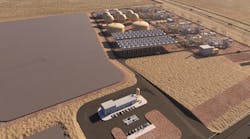
On the arid plains northwest of Fort Worth, TX, a Canadian firm is operating new high-tech water-treatment plants miles from the nearest electric utility lines.

Article Tools

Create a Link to this Article

By George Leposky

Comments

The water being treated is a byproduct of drilling in one of North America’s largest reservoirs of natural gas, the Barnett Shale Formation. Because treatment takes place close to the wells from which the wastewater emanates, the company—Aqua-Pure Ventures Inc., of Calgary, AB—can power its plants with generators running on natural gas.

“The system is totally self-contained,” says Patrick Horner, Aqua-Pure’s process engineer. “It needs no external source of electric power. We draw natural gas directly from the well to run the compressor and to drive the generator, which produces electricity to power the pumps, instruments, and controls.”

Aqua-Pure has three of these plants operating in Wise County, TX, the first delivered in February 2005 and the others in September. Six more have been scheduled for delivery in 2006.

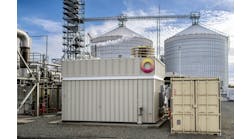
Each includes a Model GGHE 60 Hz spark-ignited 60kW (derated to 50kW for prime power application) generator set from Cummins Power Generation, of Minneapolis, MN, supplied through Cummins Western Canada in Edmonton, AB.

The engine in this generator set is a V10, naturally aspirated, 10-cylinder Ford Model WSG-1068. Sinisa Kuzmanovic, a power systems sales representative for Cummins Western Canada, says this genset is “a standard Cummins Power Generation product with a few modifications made in our Edmonton fabrication facility. Parts are readily available from any Cummins distributor worldwide.”

“We’ve had great experience with these generator sets used in other prime power applications,” Kuzmanovic says. “They’re very reliable. We’ve seen running hours as high as 20,000 logged in the field. With the extended service features we’ve added to these packages, the service intervals have been increased, allowing less downtime due to regular maintenance.”

Deep Underground
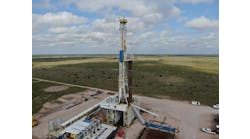
The natural gas in the Barnett Shale resides almost 2 miles beneath the surface. To fracture the gas-bearing rock strata and release the gas, producers perform a “frac job” by pumping 500,000 to one million gallons of water laced with chemicals down a well. It returns to the surface so polluted that conventional treatment methods haven’t been practical. Currently, most of this wastewater is hauled to a deep-well injection site for disposal, which is expensive and makes the water unavailable for any other use.

Aqua-Pure’s new water-treatment technology, the NOMAD 2000 Mobile Oilfield Evaporator, turns frac wastewater from a liability into an asset. Using a process called mechanical vapor recompression (MVR) evaporation, it recycles 85% of the wastewater into distilled water suitable for reuse in another frac job and concentrates the impurities into a brine. With a daily output of 2,000 barrels of reusable distilled water and 350 barrels of concentrated brine, a NOMAD unit cuts producers’ water supply, treatment, and disposal costs 50% to 60%.

Mechanical vapor recompression evaporation is a century-old technology with some inherent problems, including size. The traditional MVR evaporator employs a vertical shell-and-tube heat exchanger 8 to 10 feet in diameter and more than 60 feet tall. Because of the height, such units require firm foundations.

Modular and Mobile
But in the Barnett Shale region, individual wastewater sources typically don’t exist long enough to justify the cost of a fixed recycling unit nearby—or the cost of running electric utility power to a temporary site. To overcome these challenges, a treatment plant must have a small footprint and be readily transportable at intervals of several months while operating at enough capacity to function efficiently and cost-effectively.

“We’ve come up with an innovative modification enabling us to make a mobile MVR evaporator that provides higher capacity with a much smaller facility,” Horner says. “Its footprint is similar to that of a traditional MVR evaporator—about 2,500 square feet—but it is skid-mounted and designed for highway transport on three low-boy trailers without special permitting.”

When treatment at one site is finished, the operators can drain the system, load it on the trucks with a crane, haul it to a new site, and have it set up there within a couple of days.

The system consists of three modules, each 11.5 feet wide and 12.5 feet high:

  • A pre-treatment module 40 feet long, weighing 25,000 pounds
  • An evaporator module 37 feet long, weighing 42,000 pounds
  • A compressor module 30 feet long, weighing 96,000 pounds

The NOMAD 2000 also includes interconnecting pipes, electrical connections, and the genset, which is 41.3 inches wide, 86.9 inches high, and 103.3 inches long (including 85.6 inches within the enclosure). The skids extend beyond the enclosure at both ends, a convenience when the moving crew wants to winch or hoist it onto or off of a truck. The genset’s dry weight is 1,966 pounds.

“We’ve built the highest-capacity system that is still easily mobile,” Horner says. “If we were to build one much larger, it would be much harder to move. This is the optimal balance between capacity and mobility.”

Advertisement

Gathering the Gas
Aqua-Pure pays market price—$7 to $8 per thousand cubic feet—for the natural gas to run its generators. That’s far less than the cost of building an electric power line every time a NOMAD has to be relocated, even assuming that electric utilities would be willing to build the lines and supply electricity on such a short-term basis.

“Using a diesel generator also would be much more expensive than a natural gas generator,” Horner says. “We would have to truck in the diesel fuel, making the cost of diesel to produce an equivalent amount of electricity considerably higher than natural gas.”

Next Page >
  • 1
  • 2

What Do You Think?

Post a Comment

Be the first to tell us what you think!

Post a Comment

Not a subscriber? Sign Up
 
 
*  


Get Distributed Energy Email Updates!

Get weekly news and updates through our Distributed Energy email newsletter!