

March-April 2004

In Poplar Bluff, Two Fuels Are Better Than One

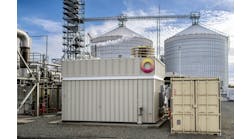
When the municipal electric utility in Popular Bluff, MO, decided to expand its peak-generating capacity, it installed dual-fuel engines.

Article Tools

Create a Link to this Article

Additional Article Content

By George Leposky

Comments

Dual-fuel engines use clean-burning natural gas much of the time and eliminate a high-cost maintenance item by using a pinch of diesel fuel instead of sparkplugs to ignite the gas. If natural gas becomes unavailable, however, the engines shift automatically and seamlessly into full-diesel operation, eliminating rigid dependence on natural gas. Even better is that they need not be brought off-line and shut down to switch fuels.

Dual-fuel is not a new engine technology. Fairbanks Morse Engine, an EnPro Industries company located in Beloit, WI, pioneered the concept in the late 1940s.

Considerations of familiarity, operational flexibility, economics, and environmental protection prompted Poplar Bluff Municipal Utilities to choose these engines. Poplar Bluff already had two dual-fuel engines that went into service in 1973, so the utility's decision-makers and staff already knew the benefits of this technology.

Adding Excess Capacity

Poplar Bluff's new installation—three 18-cylinder, four-stroke Fairbanks Morse FM-MAN 32/40 dual-fuel engine generator sets rated at 6.72 MW apiece—add enough capacity so the city won't have to pay top dollar for extra electricity when extreme weather conditions boost demand to peak levels.

Indeed Poplar Bluff now has excess capacity. To help pay for the new $14,620,000 plant, it can sell power to nearby utilities when their demand peaks exceed what their regular sources can supply.

"In 1999, we had $1.8 million in wholesale power sales with 14 MW of generating capacity. Now we have 33 MW," says Doug Bagby, who was Poplar Bluff's utilities director when the project began and now is the city's manager. "The market has stabilized in the last couple of years, but, if there are some hot summers people don't anticipate, we now have more excess supply available to the market."

Optimizing Costs and Rates

Meanwhile the additional peaking capacity lets Poplar Bluff Municipal Utilities optimize its own purchases of power from external sources. "We can reduce our firm capacity down to what we think a normal winter and summer will be," Bagby says. "We have to make sure we cover worst-case scenarios, but that's expensive if they don't happen.

"Now, if we're incorrect, we've got that peaking plant sitting there. It's going to reduce our costs just on the fact that we don't have to prepare for the worst day of the summer or winter anymore. Without it, having to buy enough power to cover ourselves even for three or four days a year would cost us a tremendous amount."

Carroll Foster, Poplar Bluff Municipal Utilities' plant superintendent, says the city's demand for electricity typically peaks at about 78 MW in July and August, with a secondary peak of 58-60 MW from mid-December through early February. Those peaks assume normal weather conditions—not the peak of the peak. In a hot, dry summer, demand might reach 80-82 MW; a cold winter could prompt demand of 68-70 MW.

Bagby points out that the new peaking plant also will help Poplar Bluff Municipal Utilities keep its retail electricity rates "more stable than they have been. We try to sell power pretty much at cost." Until a 10% increase went into effect in January 2004, rates had remained unchanged since 1987. "We might be pricing it slightly above cost in the near range," he explains, "and then before we do a rate increase, it will be a little below cost in the long term."

Firm Sources

To obtain the vast majority of the megawatts Poplar Bluff distributes to its retail customers, the city has contracted with the Grand River Dam Authority and the Southwestern Power Administration.

The Grand River Dam Authority, based in Vinita, OK, has a primary service area that encompasses 24 counties in northeastern Oklahoma. It operates four power-generating facilities: the Pensacola and Robert S. Kerr Dams on the Grand River, which together can produce up to 239 MW of electricity; the Salina Pumped Storage Project; and a coal-burning power plant in Chouteau, OK. In 1992, Poplar Bluff signed a 15-year contract with Grand River.

The Southwestern Power Administration, based in Tulsa, OK, is an agency of the United States Department of Energy. It markets hydroelectric power produced at 24 US Army Corps of Engineers dams to more than 100 municipal utilities and rural electric cooperatives with more than 7 million customers. Southwestern operates and maintains 1,380 mi. of high-voltage transmission lines and 24 substations.

"Eighty percent of the power I buy comes from Grand River, and 20% [comes] from Southwestern," reports Foster. "I buy 40 megawatt-hours around the clock from Grand River. With Southwestern, I can buy up to 39.5 megawatt-hours, not to exceed 1,200 hours a year or 600 hours within four months, and I have to take a minimum of 60 megawatt-hours a month."

If those sources and Poplar Bluff's own peaking equipment fall short of demand, Foster says, he can buy extra power from the municipal utility in Sikeston, MO, 48 mi. east of Poplar Bluff.

Modest Scale

Poplar Bluff is 153 mi. south of St. Louis and 22 mi. north of the Arkansas state line. A thriving industrial city with a population of about 17,000, it stands beside the Black River at the margin of the Mississippi Delta. East of town lie some of the world's most fertile farmland; to the west rise the rolling woodlands of the Ozark Mountains.

Advertisement

Health care is the city's largest single industry. A local hospital, Three Rivers Healthcare, employs 1,350 people. A Veterans Benefits Administration medical center has another 350 employees.

Other major employers include Briggs & Stratton Corporation, with 1,200 employees producing internal-combustion engines; Rowe Furniture Corporation, where 850 employees make upholstered living-room furniture; and a Gates Rubber Company radiator-hose plant with 460 employees. Three industrial parks in the city encompass a total of 415.79 ac.

Next Page >

What Do You Think?

Post a Comment

Be the first to tell us what you think!

Post a Comment

Not a subscriber? Sign Up
 
 
*  


Get Distributed Energy Email Updates!

Get weekly news and updates through our Distributed Energy email newsletter!