
New-and-improved technologies help companies save on energy costs, make work environments user-friendly, and reduce electrical grid loads.
Whether speaking of one-of-a-kind
technological advances or the concept and process of “bundling” to address
energy needs and savings, there’s a lot going on—hybrid daylighting, induction
lighting, light-emitting diodes (LED) roaring down the pike, new ways to control
the flow of voltage from older lamps, new lighting techniques that allow
controlling to be from a computer anywhere in the world, and putting it all
together in one bundle, from the photovoltaics on the roof to the smallest exit
sign. Clearly, energy-efficient lighting is on a roll.
The Right Technology for the Right
Problem
Energy-efficient lighting is what
the California Lighting Technology Center (CLTC) on the University of California
(UC) Davis campus is all about. Established through a joint effort of the
California Energy Commission and UC Davis to stimulate the research,
development, and application of energy-efficient lighting, CLTC is part of the
Design Department in the College of Letters and Science. CLTC’s Director of
Engineering, Bruce Pelton says, “We use the university and college system as a
test bed. Right now, we’re using four parking lots on campus to test three
lighting systems. Moving towards white light, we’ve conducted trials on bi-level
metal hydrate, LED, and induction lamps. We’re technology neutral. The trick for us is finding the right
technology for the right problem.”
According to Pelton, the State of
California is looking at energy efficiency and “is outlawing low-efficient light
sources. It will soon demand that outdoor fixtures are controllable.”
Working with local utilities,
Pelton says they paid one-third of the cost for the roll out of the 1500
induction lamps for purchase and installation. “The utilities like the long-life
property of the induction lamps with the energy reduction,” he adds. “It makes
more sense to conserve and delay the need for new energy sources. The utilities
are paid for what they produce and what they conserve. They will put a
quarter-million dollars into this project.”
 |
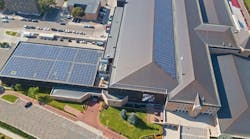
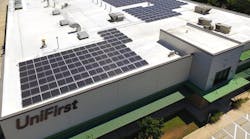
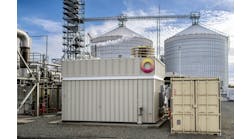
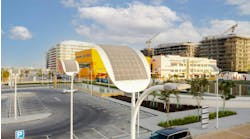
Photo: Pfister Energy Inc. From hybrid daylighting, solar, and introduction lighting to photovoltaics, green roofs, and wind turbines, thre's a lot going on in energy-efficient technology. |
What’s being tested at UC Davis
can easily extend to the 11 campuses in the UC system, state universities,
community colleges, and state buildings. “The State of California is one of the
largest landlords in the world,” says Pelton.
And he loves the 100,000-hour life
of induction lamps. “As they use 4,380 hours per year, that means in excess of
20 years,” says Pelton. “We’ve never had to deal with anything that lasts this
long.”
He also loves how the lighting is
intelligently controlled, and spoke of proximity detection—lighting at night in
public places where an area with full brightness broadcasts that someone or
something has been there. White light and proximity detection “effectively
extends a police department’s scene. So with induction lighting, we’re enhancing
security,” says Pelton.
Although he sees a growing future
for LED lamps, he says that out in the world at nighttime they are a problem
because, with the efficiency of LED’s, it’s hard to control the distribution of
the light. In addition, since induction lighting is currently one-third to
one-half the cost of LED’s, it makes sense for the University to move towards
induction lighting for exterior lighting.
For parking structure needs,
Pelton is particularly pleased with induction lamps, and recently rolled out
with 1500 EverLast 85-watt step-dimming fixtures from Full Spectrum Solutions
Inc. of Jackson, MI. The campus and the utility are happy with the power
offset—a 40% reduction in energy use. The new EverLast gives a lamp rating of
100,000 hours, and Full Spectrum Solutions claims energy savings can reach 60%.
The EverLast fixtures have unlimited on/off cycles and instant restrike
features, allowing for occupancy sensors or frequent switching with no effect on
lamp life. With the long lamp life and lower ballast losses, Joelle Kolhagen,
Full Spectrum’s marketing director, says, “We see EverLast making the largest
impact anywhere that the lifetime cost of lighting fixtures is considered.”
Pelton adds that the switching is
good, as is the transition from low to high levels of light. He says that the
University is satisfied with the cost/value proposition of induction lighting.
However, he doesn’t recommend it for a retrofit project, especially when adding
a proximity detector, as that demands even more wiring.
Response to Meet Demand
Just out in 2008 from Universal
Lighting Technologies is Demand Control Lighting (DCL) Systems Controls with
DEMANDflex ballasts. As Rick Lewis of Gish, Sherwood & Friends marketing
company explains, “All the communication takes place on the circuit level. The
DCL box talks to the ballast and can control each circuit individually, or all
together. The system can control multiple buildings and can be controlled from
anywhere in the world. With your permission, the utility company can access your
lighting to lower it.”
This new system has dominated
Universal Lighting’s research and development with beta testing ongoing for two
years. “This is taking an entire intelligence system—manual or automatic—to
manage an energy system at a very sophisticated level,” says Lewis. Customers
can retrofit existing ballast with the DEMANDflex ballast, then tune the ballast
to the proper level during installation. “At that point, or at a later date,
customers can install the DCL controls at the circuit level with no additional
wiring, which can then control from one to 50% of the amount of power supplied
to any of the circuits. This allows for precise continuous dimming to what is
desired, say 37% or 42% instead of the traditional step dimming of 10 to 20 to
30%,” says Lewis.
 |
Credit: These four products are by: Natural lighting Co. Natural Lighting's hybrid daylighting unit uses T-8 or T-5 fluorescent lamps and automated controls. |
 |
| Roofing and installation of daylighting systems |
 |
| Passive daylighting and T-5 4-lamp hybrid system with integrated lighting controls daylighting only. |
 |
| Currently, a big market for the hybrid daylighting system is in schools. |
One of the first companies to use
the new DCL control with the DEMANDflex ballasts was Ganahl Lumber, a
family/employee-owned company in southern California dating back over 100 years.
Brad Satterfield, General Manager at the Costa Mesa, CA, branch says, “Southern
California Edison came to us and said, ‘We’re trying to get everyone smarter
about electricity—lights and air conditioning. Let’s go after the lighting
first.’ They gave me a list of two or three installers to work with.”
Satterfield chose Energy Controls
& Concepts (ECC), who “did a survey and needs plan and figured out the
savings from rebates from Southern California Edison. During that process, the
Universal Lighting DCL came out, and Edison supported it fully,” he adds.
He began with a trial retrofit on
his 3,000–square foot office. “I can’t tell if they’re dimming the lights or
not, but the quality of the lighting is much better,” says Satterfield. “We
needed new lights anyway. The biggest delay was waiting for Southern California
Edison to decide about the rebate for our 20,000–square foot store. Edison gave
a significant amount. I don’t want to tell you how much—I think I was the very
first to do the Demand Response Lighting. Now our Buena Park [CA] location has
it, too.”
Satterfield feels that Ganahl
Lumber got “such a great rebate because I got involved at the right time. Even
more, ECC pushed it through with Edison. They wouldn’t have done the DCL on
their own. ECC got it moving on the market; they were awesome, I must say. Our
lighting costs are down about 25%, which is what they told me it would be. And
I’ve got better lighting, so it’s win-win.
“Edison can pull the lighting down
to 80%,” he continues. “Nothing tells me if the lights are down by 20%.” There
were no installation issues, and “the Demand Response Ballast are perfect,” he
says. “We used to have bulbs going out—now zero, at least so far—and the
lighting is better. We did the office three years back, and the store a year and
a half ago. I’m glad we did it. You do have to be patient with the installer to
get the best rebate possible from the utility.”
Controlling Consumption
From Robbinsville, NJ, comes the
Lighting Voltage Controller “WattManager,” from Magnetic & Transformer
Technologies Corporation. The head engineer is Samir Fattohi. Born in Iraq and
educated in Germany, he created and patented a simple one-step solution to
controlling lighting energy consumption up to 28%, for use with high-intensity
discharge (HID) and fluorescent lighting systems. “This is a huge market that
has been completely ignored by energy saving retrofits until now,” says
Fattohi.
The WattManager is clever. HID
lamps take from 10–18 minutes to warm up when first turned on. After that, the
WattManager’s circuitry lowers the voltage flowing from the lighting panel to
individual fixtures. “When the lamp gets warm, we reduce the power, and
customers save electricity,” says Fattohi. “Then, after two or three hours,
depending on the age of the lamp, it gains some of the lumens again. We say the
brightness dims by 4% to 8%, but it could be 2% to 6%. It’s all below the level
of human perception. Another good thing is that some people have installed,
let’s say, a 250-watt lamp that is too big for their needs. With our unit, they
can reduce the wattage without changing lamps.”
The WattManager controls any
ballast-based gaseous discharge lighting system. One WattManager can reduce the
energy consumption of 1, 10, 100, or even 400 lighting fixtures, depending on
the size of the appliance ordered. “You can measure the savings after 20 minutes
from turning on the lights,” says Fattohi. Running the lamps at a lower watt
power reduces the operating temperature, therefore prolonging the life of the
lamps and the ballast “by up to 40%,” claims Fattohi.
Fattohi first applied for a patent
on his WattManager in May 2004, and he received it six months later. His
WattManager works on older fluorescent lamps, such as T-8’s and T-12’s, but not
on the new T-5’s. “T-12’s account for 80% of the US Market for the last 30 to 40
years, and the T-8 is less than 30 years old,” says Fattohi. “In the United
States, T-5’s are only a few years old, and we’re still having trouble with
them. We don’t have enough experience with them yet.”
Vic Avila, Facilities Manager of
Maintenance Services-Facilities for the City of Hayward, CA, has WattManagers in
two different city parking garages. The first installation involved the retrofit
of a 300-car parking garage. The second was part of new construction.
“We realized about a 10% to 12%
savings in the retrofit,” says Avila. “They said we’d have a 15%, but a 10% to
12% savings is still a 10% to 12% savings. In 2007, we opened another parking
lot with about 600,000 square feet that holds 360 cars. So, we have two
different generations of WattManagers. I can’t say what the savings are in the
new lot, because it’s always been there.”
So far the system has worked
perfectly, adds Avila. He doesn’t recall reaping any rebates, but says, “it’s
likely that we would today.” Learning that the WattManager works beautifully in
offices with T-8 fluorescent lamps, Avila remarks, “I'm going to look into it
when I get the time.”
Bundling for the Future
Creating energy-efficient lighting
can be seen as a “standalone” process, or, looking to the future, it may make
the best sense to include it in what is called “bundling,” or the integration of
various technologies in an energy conservation program. Bruce Bilbrey, vice
president of Natural Lighting Company, in Glendale, AZ, says, “Energy managers
have realized that ‘cherry picking’ individual savings [for example, lighting
retrofits] only serves to limit their ability to do more broad-based and
long-range energy planning, and handcuffs them when they want to evaluate ‘big
ticket’ items like photovoltaic [PV].”
Bundling is a process of including
conservation measures with multiple technologies to provide the customer with a
comprehensive solution for long-term savings. “An example would be to do
lighting retrofits, energy management systems/controls, daylighting, and PV,”
says Bilbrey. “The lighting retrofits lowers the non-daylight energy usage; the
daylighting keeps lights off during the day and allows a more modest/affordable
PV array to power other areas of the facility. The key to bundling is to do all
the conservation measures and energy retrofits together, and run the financial
calculations as one project to allow the lower payback solutions to support the
higher payback solutions.”
 |
Photo: Full Spectrum Solutions With a lamp rating of 100,000 hours, Full Spectrum's new Everlast fixtures have unlimited on/off cycles and instant restrike features, allowing for occupancy sensors or frequent switching. |
According to Bilbrey, the idea of
bundling started with big energy service companies like Honeywell, Sylvania, and
Siemens on military bases. They’d put “perhaps a dozen different energy
solutions mixed together into one contract for the whole base,” he says. As a
small company, Bilbrey says “it’s becoming a way for investors to build a
business, by bundling four or five companies with different solutions and take
that to the market. So it’s both for creating businesses and taking the bundled
solutions to customers. Many small technology companies still get brought in as
sub contractors, just as we are a ‘solutions partner’ sub-contractor for
Honeywell and the utilities.”
Natural Lighting Co. started
bundling for their customers, first with Frito-Lay, at the Casa Grande facility
in Arizona. There, they bundled daylighting and lighting retrofit and lighting
controls, plus occupancy sensors and automation controls on the conveyor belts.
“When they aren’t running, they automatically shut off most of the lights,
because no one is working there,” says Bilbrey. “We try to harvest every bit of
energy savings we can on a site, right down to the old exit signs and their
incandescent bulbs.”
Bilbrey feels that utilities like
bundling because, “they end up dealing with one contractor, having just one
point of contact and one warranty. So it’s best on the customer and the supplier
side. Plus, you can cash flow big-ticket items with solutions that have a better
payback. “We’re a smaller company, and it gives us a better piece of the pie,”
he says. “Take Pfister Energy—they’re on the roof with their roofing company and
solar stuff, and they can do the daylighting installation.
“And,” he continues, “they have
electrical people onsite, so they can do the lighting controls. With bundling,
the customer no longer has a constant parade of contractors.”
Wayne Pfister, President of
Pfister Energy, agrees. “We’re a renewable energy company, and we offer a little
bit more of a holistic approach,” he says. “Our role is to come into a facility
to find what components work best. Many variables drive us—lighting,
daylighting, and photovoltaic. Most companies have a product to sell, thus, a
narrow point of view. We started with photovoltaic three or four years ago, but
we don’t sell it if it doesn’t make sense. There’s no single golden arrow for
every solution.”
Which brings one back to bundling,
according to Bilbrey. “The concept of bundling challenges the traditional
cost-accounting process where every solution stands alone and must meet certain
return-on-investment [ROI] standards,” he says. “Bundling requires a stronger
commitment to evaluating a facility, and a more long-term focus than the old
standard where the best ROI gets the budget allocation.”
Harnessing the Daylight
Daylighting systems are
sophisticated, engineered skylights with highly reflective lightwells that bring
diffuse, bright light into buildings, allowing facilities to significantly
reduce power consumption by diminishing the total burn hours of electric
lighting systems. A smart twist on daylighting began about 10 years ago with the
Natural Lighting Co.
Innovation seems to be locked in
the DNA of the Bilbrey brothers—founders and owners of the company. Their
“twist” came in developing hybrid daylighting, and they continue to innovate
with this efficient lighting system. Bilbrey says, “We went to Home Depot and
bought a two [feet] by four [feet] lay-in fixture, cut it up, restyled it a
little bit, and installed it in our office where we had daylighting. It was our
first prototype hybrid daylighting.”
Daylighting is more like a light
fixture, in part because “Architects always say how cluttered ceilings got and
that drove us to create a combination fixture,” says Bilbrey. “Every daylighting
product, whether active or passive, is a knockoff on what we’ve brought first to
market.”
Pfister, a licensed distributor
for the Natural Lighting Company’s product line, says of daylighting, “It’s one
of the quickest return on
investments and can offset lighting, in some situations up to 70% to 80%.”
A big market for the hybrid
daylighting system is schools. In Arizona, for example, “If a school uses our
daylighting system, they get the equivalent of 20 cents per saved kilowatt-hour
for one year’s worth of savings,” says Bilbrey.
Currently, Natural Lighting’s
hybrid daylighting unit uses T-8 or T-5 fluorescent lamps, and “in every project
we put in automated lighting controls to maintain the proper lighting level,” he
says. “Late in the afternoon, we begin sequencing lights—then at night, the
lights are on.” Their hybrid daylighting units can be used for hi-bay, low-bay,
and finished ceiling designs, both for new construction and retrofit
projects.
Now the company is pushing the
lighting “window” by experimenting with LED’s in hybrid daylighting—introduced
in May 2008 at the International Light Fair in Las Vegas. Bilbrey also has a
demonstration project at a community college in Chandler, AZ. A huge advantage
of LED is that there is no ballast and no ballast maintenance, “so the fixture
design is very simple and less expensive,” says Bilbrey. “This drew us to LED,
along with the new white light—like daylight.”
Although he admits that LED ”is
not quite there yet, in terms of light output and price,” those areas are
changing quickly. Bilbrey says that LED’s output has grown “10 to 20 times over
the past three years, and lamp costs are half of what they were 12 to 18 months
ago. All the big lighting manufacturers—[such as] GE and Phillips—are very
heavily invested in producing LED lighting products.”
Compared to a T-8 fluorescent
lamp, an LED lamp uses half the energy. “LED is 13 watts for the four-foot lamps
we use, verses 32 watts for a T-8,” says Bilbrey. That alone bumps up the energy
savings from 70% to 90%. Since LED lamps last from 50,000 to 75,000 hours, that
means lower energy costs and virtually no maintenance for 15 years, with the
bonus of a much simpler fixture design.
Bilbrey didn’t try induction
lighting for the hybrid daylighting, even though “induction lighting is one of
the technologies more people are getting excited about,” he says. Induction
lighting technology involves a fluorescent lamp without electrodes. The power to
produce light comes from a system containing a discharge vessel, power coupler,
and generator using an electromagnetic field.
“It’s great for areas that are
hard to get to or are expensive to service, but with induction lighting you have
to take what they have as a product,” says Bilbrey. “There are pre-made,
pre-built fixtures, so for us it’s a much more limited scope. With our LED, we
can make any size product that we want. We get an idea; go into our shop; and
chop, and whack, and put it up.”
Bilbrey sees much in store for
LED, but adds, “To be real honest, we’re inching along with the LED daylighting
hybrid. We want a few demonstrations first; we’re not selling it real hard right
now. With new technology, people stand back and watch.”