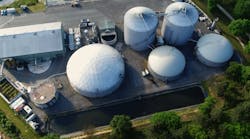

University of Arizona increases turbine efficiency with ice storage.
In addition to better efficiency,
cogeneration offers reliability and lifecycle cost advantages. Cogeneration is
more reliable than merchant generators for electrical service, because it is
committed exclusively to electrical needs of the customer. Source efficiency is
improved, because cogeneration assets are in close proximity to where it is
consumed, which dramatically minimizes the energy losses that are normally
incurred in having to transport electricity over long distances. This efficiency
is especially applicable for large consumers such as universities and hospitals,
since they have a need for large amounts of heat most of the time.
Cogeneration designs that can
effectively level the heat and power loads near full load are most ideal since
turbines that operate near full load are more efficient. According to the
California Energy Commission, “When less than full power is required from a gas
turbine, the output is reduced by raising the turbine inlet temperature. In
addition to reducing power, this change in operating conditions also reduces
efficiency. Part-load efficiencies [50%] load are approximately 25% lower than
full-load efficiencies.”
So, what can be done when heat and
power loads are not level? This was the quandary faced by the University of
Arizona, in Tucson, AZ. Five years ago, the University installed two very
sophisticated and ambitious cogeneration plants. As the University expanded its
campus, daytime electrical needs allowed full use of their solar gas-fired
turbines, which in turn created sufficient heat during the day. At night,
however, when the rest of the campus’s electrical requirements were reduced, the
University Medical Center still needed heat for sterilization, laundry, and
such. So, electricity was not only being produced under less-efficient
conditions, two ancillary Rentech (2–50 kilobyte pounds per hour) boilers were
needed to produce sufficient heat to meet hospital requirements. The innovative
minds of senior staff technicians Gordon Bush and Marianne Deutsch, as well as
Ned Morris, Trane senior sales engineer, rectified this dilemma. The mechanical,
electric, and civil design was the responsibility of Henry Johnstone at GLHN
Architects and Engineers. Together, they created a simple and innovative
solution relative to this obvious waste.
 |
| Photo: University of Arizona |
Energy Independence
The team opted to resolve their
quandary by creating a useful application for nighttime electricity in order to
get the needed heat as a byproduct of operating the turbines at night. Ice
storage was explored as a viable solution for this dilemma.
Essentially, ice storage uses ice
produced at night to cool buildings the following day. Ice storage serves the
useful purpose of providing a nighttime load for the cogeneration plant (the
ice-making chillers require electricity to operate), as well as to provide extra
cooling capacity to meet cooling loads on the next day. Other unique benefits of
ice storage include giving the University added flexibility during equipment
downtime for scheduled chiller and turbine repair and maintenance.
Ice storage technology is both
common and unique. It is common since it does for cooling what a domestic water
heater does for hot water. As a unique cooling option, ice storage is the only
air-conditioning system that utilizes plentiful nighttime-produced electricity
to generate and store daytime cooling. As a result, it provides the key benefit
of lowering greenhouse gas emissions, along with reducing the cost of cooling
from on-peak electric demand. In utility-driven cooling applications, ice
storage provides a nighttime electric load to store cooling. In the University
of Arizona cogeneration application however, ice storage not only stores the
cooling, it also provides a nighttime electric load in order to produce steam
for use by the University Medical Center.
University of Arizona
With a student population of over
37,000 and supporting approximately 216 buildings on a 378-acre campus, the
University facility infrastructure consists of three central plants: the Central
Heating Refrigeration Plant (CHRP), the Central Refrigeration Building (CRB),
and the Arizona Health Sciences Center (AHSC). These plants are hydraulically
connected with all distribution and production controlled and optimized by a
Trane Tracer Summit building automation system. This means that chilled water
produced in any of the plants can be delivered to any corner of the campus.
The CHRP was built in 1950 and has
8,500 tons of centrifugal refrigeration chilled water capacity along with
154,000 pph of 125-psi steam capacity from three gas-fired boilers. It also has
a 6.5-MW, gas-fired turbine generator with an auxiliary 1.7-MW steam turbine
generator that produces electricity for the campus grid, along with 33,000 pph
of 125-psi steam from the Turbine Exhaust Heat Recovery Steam Generator
(HRSG).
The second central plant, built in
1968, is the AHSC. It has 7,200 tons of centrifugal refrigeration chilled water
capacity along with 70,000 pph of high-pressure steam capacity, which is
produced by two gas-fired boilers and 24,000-pph-high-pressure steam from a
4.5-MW gas turbine at HRSG.
The CRB is of 1988 vintage and is
the home of the Ice Storage System. When its three ice chillers make ice, the
system has 15,650 tons of centrifugal refrigeration chilled water capacity.
However, when the chillers produce chilled water, that capacity is increased to
17,000 tons.
The Ice Plant
“The ice storage system [also
known as the thermal storage project or ice plant] is powered by a Combined Heat
and Power [CHP] system located at the AHSC plant, that supplies electricity to
three Trane CenTraVac ice chillers,” says Ned Morris Trane’s local
representative. “These chillers make ice at 910 tons and 0.783 kilowatts per
ton. They freeze water in the 156 storage tanks that are discharged on demand,
providing 23,400-ton hours of capacity or 3,120 tons for 7.5 hours. We often
accelerate the discharge to as high as 3,500 tons during peak hours, further
reducing electric demand charges.”
 |
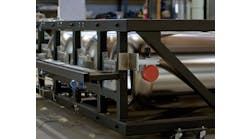
Photos: University of Arizona CALMAC Ice Storage tanks located at CRB plant |
 |
| Green Seal-certified low-pressure Trane CenTraVac |
The use of ice storage for
recovering turbine heat means the AHSC Plant Turbine is now loaded during
off-peak hours, thereby reducing the higher natural gas cost for boiler steam.
In turn, chilled water costs are kept to a minimum by reducing the number of
chillers that need to run at peak-demand periods.
When fully loaded, the Deltak Heat
Recovery Steam Generator (22 KP pounds per hour) produces 24,000 pph of
high-pressure steam, most of which is used by the AHSC, as well as by the
University Medical Center and its surrounding buildings. The auxiliary steam
turbine can be used to generate electricity during periods of excess steam
production, if the chilled water load allows.
The ability to choose gas or
purchased electricity, combined with the ability to move or reduce electric
demand with ice storage, provides tremendous negotiating power with the local
utility
suppliers.
Ice is produced at the CRB during
the evening and at night, and is melted to produce chilled water during the day.
However, during winter evenings when the campus chilled water load falls below
5,000 tons, the resultant electric load on the AHSC 4.5-MW solar turbine is
unable to meet the University Medical Center and Sciences Center buildings’
steam demand. In these situations, the ice chillers are brought online to
produce ice, raising the electrical load on the turbine, and thus producing the
needed steam.
With 10 years of steady investment
in chilled water distribution infrastructure, the University has created a
chilled water grid with less than a 12-psig-pressure differential across the
1.3-mile campus diameter. As a result, chilled water produced by the ice storage
system can be distributed across campus during the day to displace production by
any chiller connected to the utility’s electrical grid and distribution loop.
“Shaving this peak represents up to a $38,000 monthly savings to the
University,” notes Deutsch.
In addition, prior to ice storage,
the chillers needed to “cycle” in order to meet fluctuating cooling loads. With
ice storage, the chillers can run constantly at the same level of output, which,
in turn, optimizes the turbine’s efficiency and extends the life of the
chillers.
University of Arizona
representatives investigated ice storage by visiting several installations that
use this technology, including CALMAC’s installation at Shell Point, a
retirement community in Ft. Myers, FL. “Eventually the CALMAC system was chosen
because of its tanks’ non-corrosive material, the ability to isolate modules in
groups of three (IceBank tank model 1500C), the mobility of the tanks, their
ease of installation, and the ease of maintenance and repair,” Bush. “An
additional consideration was the simplicity and modular nature of the CALMAC
system. We started on June 1, 2004 and produced our first batch of ice on July
1, 2004. We have had ice available everyday, without exception since then. We
would not have made this tight schedule without our piping partner, Sun
Mechanical, headed by Scott Candrian.”
The original plans called for
23,400 ton-hours (3,000 tons for eight hours at 39 degrees), however up to
23,400 ton-hours from the system at a higher discharge temperature for longer
melting periods was delivered. Today, the system relies on 156 tanks at about
150 tons per hour each.
The original system has worked
well, and there is a new project under construction. Another 49 tanks and a
1,250-ton Trane chiller were also ordered, for an increase of 7,350 ton-hours of
ice storage at the CHRP. The 1,250-ton chiller can be used for both ice and
chilled water generation.
University of Arizona’s decision
to use ice storage involved many factors, including economical and
environmental. While ice storage is generally touted as a cost-saving cooling
option, in this instance, ice storage also provided the unique ability to
dramatically increase cooling capacity, while improving the overall efficiency
of the plant. To the University, these concerns were of paramount
importance.
Ice storage also provides the
University with greater flexibility in chiller and turbine maintenance
scheduling, yet another benefit of base loading the turbine generation.
Ice Storage contributes to N+1
redundancy as well, an intrinsic concern for any engineer. While the University
has sufficient capacity in place to meet its current daytime, peak-cooling load,
ice storage serves in a standby capacity. Furthermore, should any chiller become
inoperative, another chiller can be called into action without disruption to the
service.
Computer-Modeled
“The efficient integration of all
these loads could be a logistical nightmare,” explains Deutsch. “That’s why we
recently installed highly sophisticated software to help optimize our energy
consumption.” This software enables plant operators to monitor, control, and
evaluate energy flows and costs.
The software creates up to 48
possible operating scenarios with different mixes of plants, chiller, boilers,
pumps, towers, and ice storage. Operators can then choose the optimal scenario
on the basis of cost, maintenance schedules, campus building schedules, and the
weather forecast. “Ice storage has given us the flexibility we needed to
maximize our efficiency with the production and use of energy,” adds
Deutsch.
Saving
energy, reducing costs, and lowering polluting emissions are an integral part of
the University of Arizona’s mission of providing a comfortable, affordable
learning experience for its students. The University facility managers are
charged with maximizing the utilization of available resources and are committed
to cogeneration. Challenged with having to provide heat to the hospital, they
were also faced with having to cogenerate that heat. Ice storage met that
requirement by consuming the cogenerated electricity, leveling the load, and
improving efficiency and lowering emissions.