


September-October 2006

  • 1
  • 2

New Orleans Generators: High and Dry

After Hurricane Katrina, generators installed above the flood that struck New Orleans continued to run, while those at ground level drowned.

Article Tools

Create a Link to this Article

By Rosalie E. Leposky

Comments

Where should standby generators go? Routine locations include a basement utility area or a concrete pad at ground level behind a building—but the flooding associated with Hurricane Katrina in New Orleans submerged many such installations.

By contrast, generators installed above the level of the flood performed well and continued to perform until they were turned off as buildings were evacuated for security issues and health concerns raised by standing water.

The ease with which many generators drowned in New Orleans should alert building designers working in a flood zone anywhere. Instead of sequestering noisy, unsightly equipment in a subterranean hideaway, architects and engineers should place boiler rooms and emergency generators as strategically as surgery suites and neonatal intensive care units—well above the ground floor in a protected location with significant ventilation.

“Before Hurricane Katrina we followed design requirements and installed generators where we now know they never should have been located. They all were submerged in water—a very costly lesson,” says Chad Lemoine, a New Orleans-based sales representative for Stewart & Stevenson, LLC of Houston, TX, a Detroit Diesel Corp. distributor. “My best guess is that 75–100 major New Orleans facilities lost all of their backup generators.”

In April of 2006, S&S still had back orders to replace destroyed generators for businesses, hospitals, and schools. He hoped they would be delivered and installed before the height of the 2006 hurricane season.

Orders for many other installations haven’t been placed yet because their owners haven’t secured funding for replacement generators. At least eight generators at the Louisiana State University Medical School in downtown New Orleans were flooded and need to be replaced.

“At the LSU Medical School and in other hospitals and institutions, there’s a push to install the new generators on higher floors, but doing that increases the cost,” Lemoine says.

Suman Jolly, an electrical engineer, owns Jolly Consulting Inc., in New Orleans. “We are now elevating generators in emergency call centers, hospitals and nursing homes, prisons, designated shelters, and other public buildings to high elevations or to the roof of two-floor buildings,” he says.

Pumping Station Improvements
With much of New Orleans built below sea level, the city relies on pumping stations for drainage after a heavy rain or a levee breach. “New Orleans plans to spend millions to build shelters at each pumping station so pump operators will be safe to ride out hurricanes through a Category 5 storm,” Jolly says. “All pumping stations’ pumps now have backup generators, and some are being automated with remote controls in case something happens to the operator.

“All of the pumping stations have their own diesel tanks. Pumping station generators vary in size from 1.500 MW to 3 MW and are many different brands. New generators are being installed on higher platforms, 15–30 feet above ground level depending on the individual site’s elevation.”

In much of New Orleans, grid power is distributed underground instead of on poles. When the city flooded after Hurricane Katrina, the distribution system in flooded basements was lost.

“We learned a hard lesson,” Lemoine says. “Our generator business has grown every year, and not particularly because of the 2005 hurricanes.”

The sheer magnitude of electrical outage, in New Orleans and elsewhere in Katrina’s path along the Gulf Coast, demonstrated the fragility of the power grid and the importance of alternative sources of power.

Flooding is worse than wind. Surging floodwaters can move entire buildings. Those that remain bear horizontal stripes, showing the height that the flood reached and intermediate stages in its slow ebb. Buildings so marked show the minimum elevation at which new generator installations must be placed. The best such installations will be within the protective envelope of a building’s structure, but where that kind of space doesn’t exist and can’t be created, the next best place is a rooftop.

Wind can blow away even heavy equipment that isn’t securely anchored. Hardening a rooftop generator installation may involve the use of long bolts to attach the skids to I-beams anchored in the roof structure, or set in epoxy-filled holes drilled in a concrete roof. Then roofers seal the area around the bolts so it doesn’t leak.

First Responders
Hurricane Katrina made landfall west of New Orleans at Buras-Triumph, LA, early on Monday Aug. 29, 2005, as a Category 3 storm with sustained winds of 125 mph and hurricane-force winds extending 120 miles outward from the eye. The storm swept across the city and spread eastward into Mississippi and Alabama.

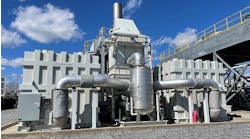
Hardening a rooftop generator installation may involve the use of long bolts to attach the skids to the I-beams. On concrete roofs, the bolts may be set in epoxy-filled holes.

In New Orleans, Katrina challenged the integrity of 350 miles of levees along Lake Pontchartrain and several canals. The 17th Street Canal, the London Avenue Canal, the Industrial Canal along the Intracoastal Waterway, and the eastern New Orleans levees were breached or topped by the storm surge. Also, a barge broke lose from its moorings and punched a hole in one of the levees. About 80% of Orleans Parish (the City of New Orleans) was flooded, as were most of neighboring Jefferson and St. Bernard parishes.

Jefferson Parish President Aaron Broussard turned off his parish’s pumping systems and evacuated the operators during the storm, a decision on which flooding of most of the east bank has been blamed.

Three days after Katrina struck, S&S technicians Wayne Estrada and Peter Robichaux, and the latter’s son, Jeffrey P. Robichaux, preventive maintenance foreman, returned to the firm’s complex in suburban Jefferson Parish.

“They found wind and rain damage—about 6 inches of standing water, our roofs practically blown off, and the big sliding bay doors blown off the front and back of our shop,” says Gary J. Eiermann, electrical shop supervisor.

“Before considering our own cleanup and restoration, they collected supplies to help Jefferson Parish obtain and install temporary generators for the emergency preparedness office, hospitals, and courthouse. Everyone was down and screaming for portable generators. Fortunately we had a few rental units here waiting to be shipped back to our Houston office.

“Our Houston office emptied their warehouse to send us all of their rental generators, and took care of requests and installations for us so we could concentrate on servicing in-place generators to get our clients up and going as quickly as possible.”

In the days following Hurricane Katrina, S&S’s staff serviced hundred of generators from all manufacturers. “About 70% of all the generators we saw could be salvaged, and about 30% could not be,” says Jeffrey Robichaux.

The technicians used Nextel cell phones and radios, which worked intermittently because of high caller volume. “They were our main means of communication with our co-workers and our clients that use Nextel service, including the VA Hospital,” Robichaux says.

For a few days after Katrina, several S&S employees stayed at Jeffrey Robichaux’s home in the city of Marrero in Jefferson Parish. “The nights were scary,” he says. “You could hear a pin drop. My house sustained only minor cosmetic and roof damage. Our families stayed where they evacuated to, while we returned as first responders. Utility power was off but we had natural gas and hooked up a portable generator so we had warm showers, were able to cook, and had some lights. We were able to watch WWL-TV (Channel 4), the New Orleans CBS affiliate that stayed on the air through Hurricanes Katrina and Rita.”

WWL-TV has a 1.5 MW Caterpillar 3512B generator with a 10,000-gallon double-walled fuel tank at its Rampart Street studio and a 1 MW Caterpillar 3508B generator with a 10,000-gallon tank at its remote transmitter.

Keeping Fuel Flowing
For generators that continued to operate after Katrina, obtaining and protecting fuel became major concerns. For years, consultants have advised emergency planners to develop post-disaster diesel-fuel sources. Katrina showed that the arrangements should include both nearby and distant sources, and provisions for secure delivery.

After public services in New Orleans broke down, the military and other government agencies commandeered fuel supplies destined for private purchasers. At the same time, the S&S crew had military escorts when transporting fuel around the city to service their customers.

“Employee safety was a major concern,” Robichaux says. “People held up other people for diesel and unleaded fuel.

“We keep stored on our site about 6,500 gallons of diesel fuel that we shared with customers. Because of the high water, it was hard for a while to get diesel tankers into the city. When phone service was impossible, new customers simply flagged down our trucks and asked for fuel. We have no way to telling how many companies and individuals we helped.”

Katrina also demonstrated the need for a different kind of protection, to prevent clogging of fuel lines and filters. “After Katrina, we discovered significant problems with what commonly is called algae and fungus. It’s really a slime and sludge, consisting of clustered diesel-fuel particles,” says Robichaux.

To break down these clusters, S&S uses products made by Algae-X International, Inc., of Ft. Myers Beach, FL. “Because of the way diesel fuel is manufactured, it is naturally unstable,” says John Bennett, Algae-X operations manager. “Its quality and chemistry are continuously degraded by transportation and storage from refinery to user; oxidation; heat and pressure of engines, pumps, and injectors; and water and microbial contamination.”

Robichaux says his firm installed Algae-X filters between generator tanks and primary filters; and used an Algae-X fuel additive and combustion catalyst, AFC-705. “These items provide superior fuel quality for engines and storage tanks, and reduce operating costs, maintenance, and downtime,” he says.

Stories to Share
Everyone in New Orleans has a story to share.

A military veteran who drives a taxi for United Cab Company didn’t evacuate. He has a residential generator and a gun, so he stayed to protect his home and those of his neighbors who fled. Friends appeared with containers of diesel fuel to keep his generator going. He never asked where they got the fuel.

Generators installed above the level of the flood performed well and continued to perform until the buildings were evacuated for security issues and health concerns.

Advertisement

A hotel administrator stayed in her property during Katrina. Afterwards, the buses she secured to transport her guests were commandeered by the government, forcing her to make alternative arrangements. This same person received an exorbitant proposal from a contractor for installation of a home generator.

Some companies in flooded areas have resumed business operations, and are letting employees live on their land in trailers supplied by the Federal Emergency Management Agency until other housing becomes available.

Next Page >
  • 1
  • 2

What Do You Think?

Post a Comment

Be the first to tell us what you think!

Post a Comment

Not a subscriber? Sign Up
 
 
*  


Get Distributed Energy Email Updates!

Get weekly news and updates through our Distributed Energy email newsletter!