


September-October 2007

Total Backup Generation

Supermarkets in southern Florida prepare for the next hurricane.

Article Tools

Create a Link to this Article

By George Leposky

Comments

After a hurricane strikes, households in its wake need to replenish supplies of food, potable water, and ice—and so do their local supermarkets.

With electric utility power unavailable for days or even weeks, supermarket managers face major challenges in trying to reopen for business and meet customer demand. With only enough backup generating capacity to run the cash registers and a few emergency lights, the typical supermarket—like most of its customers—must throw away tons of meat, dairy products, and frozen food.

That’s why two grocery chains in southern Florida—Milam’s Markets and Publix Super Markets Inc., both hard-hit by the disastrous 2005 hurricane season—have made an unprecedented and costly commitment to install total backup generation capacity at many of their stores. The next time a hurricane strikes the region, they hope to avoid losing perishable food at those stores and to reopen for business as soon as the winds subside and their buildings are deemed safe.

Milam’s is a small family-owned chain with four stores, all in Miami-Dade County. Publix is the nation’s largest employee-owned supermarket chain, with 902 stores: 652 in Florida, 167 in Georgia, 38 in South Carolina, 28 in Alabama, and 17 in Tennessee. All of the Florida stores and many of the others are in hurricane-prone locations.

Backup Generation Issues
Despite their difference in size, Milam’s and Publix had to confront the same backup generation issues:

  • Will total backup generation be cost-effective? The expense to install, maintain, and operate the equipment must be measured against a potential loss of merchandise and business that seldom or never may be realized at a particular store.
  • What brand and model of generator, and what type of fuel, is best for the stores and the company’s budget?
  • What’s the best place to install a generator, considering a given store’s site layout, the security of the equipment, and the safety of the surrounding community?
  • Does each store have an established support system of fuel and merchandise suppliers, with alternative sources in case the prime suppliers can’t respond to the store’s needs?
  • Which employees at each store are responsible for the generator’s operation, what must those key employees know about the generator, and who will train and qualify them?

Exceeding Requirements
Thomas Milam had 10 children and a career in food distribution and wholesaling before founding Milam’s Markets in 1984 with his son Allen. Today, the family business is owned and operated by four of Thomas Milam’s 10 children—Allen, Mike, Max, and Marie.

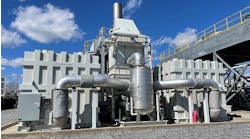
Each of the Milam’s stores has less than 30,000 square feet, and each previously had a 35-kW or 40-kW generator providing limited alternative energy generation to run emergency lights and cash registers, satisfying both the old and new Miami-Dade County requirements. Two of the four stores recently installed a new 350-kW Katolight D350FPJ4T2 generator powered by a John Deere 6125HF070 diesel engine sitting on a 1,500-gallon tank containing enough fuel to run continuously for three to five days. Reagan Equipment Co. Inc. in Pompano Beach, FL, supplied the new generators. (In April 2007, Katolight, a closely held family business based in Mankato, MN, was acquired by Tognum GmbH of Friedrichshafen, Germany. Tognum is owned by MTU Friedrichshafen GmbH, which also owns MTU Detroit Diesel Inc. in Detroit, MI. Tognum plans to continue using the Katolight brand name in the United States.)

Milam’s Markets has installed 35-kW Katolight generators at two of its locations in southern Florida.

Max Milam says all of his company’s stores face the challenges of developing a plan to prepare for storms: knowing what to order and what not to order; developing a close relationship with providers of ice, fuel, and nonperishable foods so if local suppliers are down they have out-of-town suppliers lined up to help; and—most important—knowing what their customers will need before the storm, immediately afterwards, and later during the recovery period.

Advertisement

“All of this is easier,” he says, “when we have power to operate our stores, avoiding expensive outages and brown-out periods when food that can spoil has to be thrown out. The hurricanes experienced these past several years have necessitated that all retailers take a more proactive approach in providing for emergency generation to meet the needs of the community during periods of extended power outages.”

Neighborhood Stores
Milam’s stores serve four very different neighborhoods. In the Redbird Shopping Center, a strip mall built in 1955 at Southwest 57th Avenue (Red Road) and Southwest 40th Street (Bird Road), just outside the city limits of the upscale Miami suburb of Coral Gables, Milam’s opened its first store in 1984. In April 2007, installation of a diesel generator to run the entire store was completed. Next Page >

What Do You Think?

Post a Comment

Be the first to tell us what you think!

Post a Comment

Not a subscriber? Sign Up
 
 
*  


Get Distributed Energy Email Updates!

Get weekly news and updates through our Distributed Energy email newsletter!