



While the economic landscape continues to challenge even the stout of heart, bright ideas and new marketing methods continue to light up the arena of energy-efficient lighting. The proverb from Horace still rings true today: “Adversity reveals genius, prosperity conceals it.”
Take Nicholas Ferraioli and David Cooper, partners in the new virtual USAenergyManagement and USAgreenEnergymall. They set up online sites to help customers and manufacturers alike navigate the choppy waters of going green.
Ferraioli says, “What I learned through big installations with my personal company, Suncoast Solar Power, is just how many steps are involved in doing a green energy plan. It’s like getting a mortgage, buying a new car, or getting a student loan. You have to get everything in place, and then go to the banker for the loan. Going green wasn’t a one-man answer.”
Although these sites serve people nationwide, they are zip code–sensitive. Sellers and buyers alike can find each other, and what they find simplifies meeting the various demands involved in green projects. Customers find product, manufacturers, installers, professional services including architects, civil engineers, tax specialists, and the bankers.
Cooper’s background is in software development for and management of big time fan clubs (Nascar, Madonna, U2, Pearl Jam, etc.), as well as Ticketron and Ticketmaster. He and Ferraioli already have more than a million dollars invested in software for their online green sites. “We’re really in it for the fan,” says Cooper. “If the fan gets a good deal, he’ll tell three friends, who tell three friends. This is a green energy fan club.”
Ferraioli points out the ongoing challenge for States, of determining when to release funds for alternative energy projects. “In the state of Pennsylvania, we’re working with the state and a couple of banks, with the $680,000,000 alternative energy budget, and the question arises when and how to release the money. When the utilities sign off on a system, then the banks can release the funds.”
Last spring, Ferraioli used an energy-efficient lighting retrofit project at Yuengling Brewery as one case study. “We built our return on investment spreadsheets on the Yuengling project to use as one of the online models,” he says. “People all over the country can use it for indoor lighting examples.”
 |
Photo: Full Spectrum Solutions
Retrofits can save both energy and money. |
Founded in 1829, Yuengling Brewery (pronounced Ying Ling) is America’s oldest brewery in continuous operation. It also boasts the country’s longest uninterrupted history of management by a single family. The brewery is located in Pottsville, PA, with another plant in Florida, and product distribution refreshes the East Coast from Maine to the Florida Keys. (For the curious, the brewery survived Prohibition by creating near-beer, as well as starting a dairy farm. At the end of Prohibition, the brewery sent a truckload of beer to the White House as a personal gift for President Roosevelt.)
Ferraioli approved using Full Spectrum Solutions EverLast induction lights, after first getting samples of the electrodeless fluorescent fixtures, installing, and testing them. “I liked them,” he says. “It’s a direct remove-and-replace type of installation, and the fixtures come with a 10-year warranty. It literally takes only five or 10 minutes per light to actually replace the fixture, and, in some areas, we reduced the amount of fixtures by 50% by changing out every other one.”
The retrofit, involving 495 induction lamps, reduced the plant’s lighting electrical load from 202 kW per hour to 89 kW per hour. With instant strike, a virtually maintenance-free, 100,000-hour-lamp life rating, huge energy savings, and a ROI within the first year, induction lighting was a smart choice for the brewery. The project, completed in Spring 2009, was so successful that Yuengling is moving on to retrofit their one-million-plus–square feet Tampa Bay, FL, facility, as well as their original brewery in Pottsville, down the road from the recently retrofitted bottling plant.
Bob Seaman, plant manager at Yuengling Brewery, says, “Without a doubt, the lighting in the plant is better than it has ever been before. Everyone is happy with it. And, it has dropped our lighting load by more than half. The lighting has completely changed the look of the plant. Our yellows, reds, greens, and blues jump out now. Those lights from Full Spectrum are a nice quality—we saw the difference instantly when they turned on the lights.”
The gift shop also got a lighting makeover, and knowing that the Full Spectrum lights now help protect the antique brewery items displayed in glass cases is an extra plus.
When Mark Welker, founder of Arcalux Corporation in Houston, TX, sees something he wants to invent, his partner initiates a patent research, and, “Most of the time we find a niche, and then we ask, ‘is it patentable?’ More importantly, ‘Is it marketable?’”
Welker founded Arcalux six years ago, and according to Tim Smith, Vice President of Sales, “the company has spent most of that time in research and development and getting numerous patents.”
Welker adds, “According to the 2000 census, there are 4,700,000 buildings in the USA. The fact is the largest number of lighting fixtures operating in these buildings is a florescent 2-foot-by-4-foot luminaire that has not had a change from its original housing design since 1931—the time of President Hoover.”
Since the 30s, the advancements in the lighting industry have been with the electronics (lamp and ballast), and there have been vast improvements in this area and more to come.
Welker asks, “Why not have a fixture that is modular in design, that is able to adapt to the current-and-upcoming technologies, without having to purchase a new fixture? Especially, when the customer can realize more savings with newer technology and is able to invest pennies instead of dollars when taking advantage of the next generation of electronic advancements.”
If the advancements in the “2-foot-by-4-foot Fixture Industry” were compared with the auto industry of today, we would all be driving Model-T body styles coupled with efficient hybrid engines. Why wouldn’t you want to make the car perform to the newer engine capabilities?
The SmartFixture has over 2,800 different configurations. The customer can perform retrofit upgrades to the SmartFixture without the need of tools or highly skilled labor. With the SmartFixtures one-housing concept, Welker insisted that all of the upgrades had to meet the highest performance standards possible regardless of configuration.
Currently, SmartFixture is the only luminaire in its class to qualify for accelerated depreciation under IRS Rule 179. It qualifies because the plug-n-play feature provides SmartFixture with both “portability” and “reusability,” the two components necessary to qualify for the five- to seven-year accelerated depreciation.
Arcalux engineers removed the ballast from the lamp cavity and moved it to a Ballast Rail that serves as a heat sink on the back of the fixture. This innovation removed an obstruction to lamp performance, and optimized lamp-operating temperatures, resulting in greater lamp efficacy.
 |
Photo: Full Spectrum Solutions
The retrofit reduced Yuengling Brewery’s lighting electrical load to 89 kW. |
The SmartFixture’s increased efficiency enables the use of higher efficacy F25T8 or T5 lamp technology. Energy consumption drops by 25% to 71%, depending on the existing system. Basically anyone can perform the ballast changes in less than two minutes with a simple turn of a thumb mounting screw and quick disconnects on the primary, secondary, and ground wiring. Along with high energy savings, the SmartFixture improves safety and reduces maintenance costs by up to 75%.
Visual aesthetics can also be changed with nearly any lens or louver design, again with no tools. This is with the patent-pending Shadowbox design. When its face is lowered, spring clips enable anyone to change the lens or louver in the existing Shadowbox without removing the entire fixture.
Enabling lamps to be reconfigured, ballasts to be replaced, and lenses to be changed in the field, allows the very look to change as one changes one’s mind.
There’s something in the air about retrofitting old establishments with new, energy-efficient lighting. From the Pennsylvania brewery to Maryland’s historic circuit court, Spring 2009 proved bright indeed. Richard Lee, Energy Manager for Howard County in Maryland laid out why they changed the lights. “The two primary reasons were that the circuit court house was the fifth-biggest energy user in Howard County, and 95% of the lamps were T-12s,” he says. “Those are mandated by the state to be obsolete in a few years. A third reason, although not primary, was that it’s a very old facility, and it needed a face lift.”
The County began a pilot project with Arcalux in April 2009. Based on calculations, Lee says “The energy lighting was reduced 70%, and we still have a satisfactory level of lighting. With the money saved from the lower energy usage, that translates to a six-year payback (ROI). In terms of reducing the cooling load, we still haven’t figured out that savings yet, but burning less energy means the air conditioning doesn’t work as hard.”
The pilot program started with one courtroom and 10 light fixtures. Because of its success, roll out of the program with a massive order to purchase light fixtures “to replace 95% of our light fixtures” was set for May 2009, says Lee. He adds, “We will order several hundred fixtures.” Although Howard County cut many projects due to the current financial situation, “they didn’t cut this program,” says Lee.
Lee adds, “originally we stuck to T-8, thinking they were good enough. One successful marketer (Arcalux) helped us jump-start our plans even earlier than we thought. At first, we thought we couldn’t justify T-5. Now, wherever we have T-5 applications, Arcalux could be a candidate. The next place we look at could be the libraries. We have a new library planned, the architect would be involved, and for retrofitting our existing libraries as well.
“We’re even evaluating LED,” he says. “There’s a hybrid from Waldmann Lighting, with LED direct light and T-5 for indirect light. It’s high end, with two lamps. Whatever is new in the market we want to look at. To everyone who knocks at our door, we’ll say ‘bring it in and let us see it, let us try it.’ Arcalux was so energetic they motivated us.”
Waldmann Lighting is a German company whose roots go back to the 1920’s. In the Black Forest, one finds Villingen and Schwenningen, two towns so close together that the area is called Villingen-Schwenningen. The first watch factory in Villingen-Schwenningen opened in 1858, and from then on it was known for watch making and other precision mechanicals. Waldmann Lighting started out making task lights for those local industries. After WWII, Waldmann expanded into industrial task lighting. Waldmann makes the task lights for computer numerical control programs to digitally cut metal patterns, and today controls 80% of the market share for task lights in industrial metal working machines in Germany. “That market share gave us the money to get into the field of office architecture,” says Lou Calvo, Director of Sales and marketing for Waldmann Lighting. Waldmann expanded into America in 1982 (headquartered in Wheeling, IL), and today Waldmann creates lighting for three fields—industrial, medical, and office/architectural.
 |
Photo: Lutron Electrics
Famed architect Renzo Piano says the New York Times building tells a story of “lightness and transparency.” |
Joel Spira, founder and owner of Lutron Electronics Inc., headquartered in Coopersburg, PA, invented the world’s first solid state dimmer in 1959, and founded Lutron two years later. His privately owned company experienced years of solid growth before giants in the industry invaded his territory, armed with mass production. Spira’s response? He revamped his product line to focus on mass customization. Now, nearly 50 years since inception, Lutron’s 11,000 products enjoy a global market. Being adversity-smart, Spira chose to adapt to changing market needs, changing tastes, and changing technologies rather than concentrate on economy of scale.
Which brings us to the new 52-story New York Times Building in Manhattan (completed in 2008) and designed by the world-renowned Italian architect Renzo Piano. When beginning the design, Piano said, “Each architecture tells a story, and the story of this new building proposes to tell one of lightness and transparency.”
This was Piano’s first major New York City project, and all the architects involved in the project found the New York Times Company a very different client, as the Company was a part of every decision. For example, according to Dan Tambellini, who handles some of the commercial public relations for Lutron, the Times Company went to the Lawrence Berkeley National Laboratory at the University of California “to do tests on the best lighting controls out there.”
The level of testing proved amazing. The design team and manufacturers built a replica of the southwest corner of the new building at one of its printing facilities in Queens, NY. For six months, from the winter solstice to the summer solstice, the mock-up tested various lighting technologies and products from different manufactures, including the new Quantum technology just emerging from Lutron. The design team chose Lutron’s Quantum total light management system, both because of the testing and Lutron’s response to a competitive bid.
They chose well. The building was designed to use 1.28 W per square foot of lighting power. According to Glenn Hughes, the Director of Construction for the New York Times Company, initial results indicated the building used only 0.38 watts per square foot—“that’s 70% less” says Hughes.
However, newer data indicates even better savings, broken down by seasons:
Spring (2008): 0.38 W/square foot
Summer (2008): 0.33 W/square foot
Fall (2008): 0.37 W/square foot
Winter (2008–2009): 0.37 W/square foot
What does that mean in dollars? Hughes says, “This facility saves over $315,000 each year by managing light with Quantum.”
Remember, that savings is above what the environmentally designed building called for. It also means preventing 1,250 metric tons of carbon dioxide emissions each year.
Hughes adds, “The energy usage savings is stunning. Lutron’s lighting control system has delivered an absolutely over-the-top performance. When I talk with other construction and lighting consultants, they’re astonished at the results. Total light management represents the single greatest opportunity for energy savings in commercial buildings, whether retrofit or new construction projects.” He says that Lutron’s energy-efficient system supports the 2025 net-zero energy building goals of the Department of Energy.
From the beginning, Times executives wanted a way to satisfy their twin desires for daylight harvesting and for maximum flexibility to reconfigure spaces easily and simply. Quantum satisfies both desires. Tambellini says that “Quantum is not the light fixtures, it controls the lighting, and the number of strategies and technologies is immense.”
Different strategies include daylight harvesting, light level tuning, occupancy or vacancy sensing, load shedding, architectural load dimming, fluorescent dimming, high-end trim, switching, and scheduling. Comfort and productivity increase with strategies such as personal light control, scene and zone control, and controllable window shades. As Tambellini says, concerning individual needs, “different levels of light are required when you read paper documents compared to looking at the computer screen.”
 |
Photo: Waldmann Lighting
Office/architectural lighting has inspired innovation in the industry. |
One can redesign a space very easily with a regular PC or a handheld pdf. “It even spits out a report about what lights are about to burn out,” adds Tambellini.
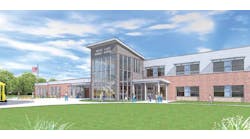
President Obama’s daughters attend the Sidwell Friends School in Washington D.C., the coeducational Quaker day school established in 1883. Lutron’s EcoSystem lighting control system was selected to be incorporated in the extensive retrofit (37,000 square feet) and new addition (39,000 square feet) of the middle school building (grades 5–8). Sidwell Friends School is the first secondary school to receive the LEED Platinum designation, and the first structure of any type in Washington D.C. to receive it.
Lutron’s EcoSystem provides energy-efficient fluorescent lighting, integrating daylight sensors, occupancy sensors, and dimming ballasts. Other components of the project include a light shelf incorporated into the facade which transmits daylight deep into the building while shading corridors from direct sun, several exterior walls sheathed with western red cedar cladding, sunscreens and high-performance windows, and photovoltaic panels providing 5% of the building’s overall electrical load.
Steve Sawyer, who maintains the grounds and facilities for the school, says: “It’s been a lot of work for us, but the results have been gratifying for everyone. Virtually every design feature took environmental responsibility into account, and that, in turn, sends the right message to the kids who attend here.”
Ingenuity, creativity, determination, and a dazzling array of new products and marketing techniques, along with a strong “can do, will do” no matter what the economic environment, means it’s a green light for energy-efficient lighting.